
Choosing the right digital marketing agency for construction companies can feel as challenging as navigating a modern digital dilemma akin to ChatGPT vs. Google for your online searches. In today’s digital landscape, contractors must establish a strong online presence to attract new and repeat customers.
Whether you’re a small startup construction company or an established contractor, finding the right marketing approach is crucial. Digital marketing for construction companies has evolved significantly, with agencies like Venveo being recognized for their excellent work by Forbes, The Wall Street Journal, AIA, and the National Association of Home Builders. In fact, despite being relatively small with only 50 team members, these specialized agencies remain connected to the needs of construction companies while staying ahead of new marketing tools and trends.
Throughout this article, we’ll compare the capabilities of ChatGPT and Google, examining their strengths and limitations for search, research, and everyday use. We’ll explore which tool better serves your needs when looking for information quickly, conducting in-depth research, or handling daily tasks giving you clarity on when to use each option for optimal results.

What are ChatGPT and Google?
ChatGPT and Google represent two different approaches to helping users find information. As tools that shape how we interact with digital content, understanding their core mechanics reveals why they produce such different results.
How Google Search Works
Google Search functions through a three-stage process that begins with crawling. Web crawlers (also called spiders) automatically discover and scan billions of pages across the internet. After finding pages, Google moves to indexing analyzing and storing information about the content in its massive database, a set of mechanics that a specialized digital marketing agency for construction companies must deeply understand. The final stage involves serving results – when you search, Google’s algorithms evaluate hundreds of factors to determine which pages from its index should appear and in what order.
Google’s ranking system prioritizes relevant content by analyzing many signals including meaning of your query, content quality, page usability, and contextual factors like your location. Rather than simply matching keywords, Google tries to understand the intent behind searches, determining whether you need news, images, definitions, or local information.
How ChatGPT Generates Responses
ChatGPT operates fundamentally differently. Instead of searching the web, this artificial intelligence service processes user questions by drawing on patterns learned from analyzing vast amounts of text data. When generating a response, ChatGPT predicts the most likely next word based on context, creating answers one word at a time.
The development process involves multiple stages of training. Initially, human AI trainers provided conversations playing both user and assistant roles. Subsequently, OpenAI applied Reinforcement Learning from Human Feedback (RLHF) where trainers ranked different model responses to improve quality. Unlike a search engine, ChatGPT doesn’t retain or copy exact training materials – it adjusts internal parameters to reflect identified patterns.
Key Differences in How They Process Information
The most fundamental distinction lies in their approaches: Google retrieves existing information, whereas ChatGPT generates new content based on learned patterns. Additionally, Google provides links to sources, allowing users to verify information themselves, while ChatGPT synthesizes responses directly.
Furthermore, Google updates its knowledge through continuous crawling of the internet, ensuring access to recent information. Conversely, ChatGPT’s knowledge is limited to its training data cutoff point, though newer versions can access web information through services like Bing.
Lastly, their interaction models differ significantly – Google traditionally offers one-way information delivery through search results, although this is evolving with AI features. ChatGPT provides conversational interactions, allowing follow-up questions and maintaining context throughout exchanges.

Search Comparison: Speed, Accuracy, and Relevance
The battle between ChatGPT and Google extends beyond their underlying technologies to practical differences in performance that impact everyday users.
Which is faster for finding quick answers?
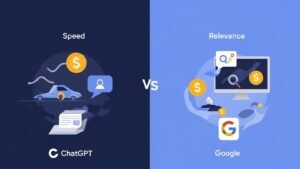
Speed remains one of Google’s decisive advantages. Google delivers search results in approximately 0.3 seconds, meanwhile ChatGPT responses take around 6.8 seconds to complete a difference of 22x. For users seeking quick factual lookups, this time gap proves significant. Google’s technical infrastructure processes over 8.5 billion searches daily while maintaining sub-second response times.
How accurate are the results?
Accuracy varies dramatically depending on query type. For company-specific facts, Google returns accurate information 94% of the time by connecting users to official sources, comparatively ChatGPT’s accuracy rates around 76%. Nevertheless, in specialized domains, the balance shifts. A Harvard study examining anterior cruciate ligament reconstruction information found ChatGPT responses scored significantly higher in both correctness and completeness than Google search results.
Relevance of results to user intent
Both platforms interpret user intent differently. Google excels at understanding diverse search scenarios, having collected data on user interactions since 2004. According to research by BrightEdge, Google treats action-oriented queries as requiring information, consequently ChatGPT interprets them as needing tools. This creates distinct search experiences ChatGPT functioning as a decision coach, whereas Google operates more as a research assistant.
Handling of current events and real-time data
Google maintains undisputed dominance regarding real-time information. When news breaks, stock prices shift, or weather patterns change, Google’s systems update within minutes or sometimes seconds. Indeed, for time-sensitive information queries like current weather or stock prices, Google provided accurate up-to-date information 98% of the time in controlled testing. ChatGPT responses typically reflect information 6-24 hours old, making Google the clear choice for current events.
Research and Daily Use: Which One Helps More?
When comparing digital tools for productive work, the decision between ChatGPT and Google often depends on your specific task and goals.
Using ChatGPT for brainstorming and writing
The creative capacity of ChatGPT shines most brightly during the ideation phase. Research shows marketers spend nearly twice as much time with ChatGPT compared to other teams approximately 18 minutes daily versus 10 minutes for IT and sales professionals. One content strategist reported that ChatGPT saved them two hours of “blank-page syndrome” by generating 30 headlines in just 11 minutes. Furthermore, researchers using AI tools published 67% more papers, received three times more citations, and advanced to team leadership positions roughly four years earlier than peers who avoided AI assistance.
Using Google for in-depth research and sources
Google remains the preferred tool for gathering credible information and sources. Despite ChatGPT’s growing capabilities, professionals still rely on Google for knowledge-base lookups, vendor documentation, and error logs. For specialized searches, Google Scholar provides access to peer-reviewed academic sources that ChatGPT cannot match. Moreover, Google’s Deep Search in AI Mode offers comprehensive research by browsing hundreds of websites, analyzing findings, and creating fully-cited reports.
Productivity tools and integrations
Each platform offers distinct productivity advantages. Google seamlessly integrates across its ecosystem Gmail, Docs, Sheets, and Search making it particularly valuable for Google Workspace users. Conversely, ChatGPT excels with multimodal capabilities, handling images, PDFs, and CSV files while offering specialized custom GPTs focused on specific tasks.
Limitations in daily use scenarios
Both tools present notable drawbacks. ChatGPT struggles with internet access limitations for free users and may provide inaccurate information with confidence. Primarily, Google search results can be manipulated through SEO optimization, potentially prioritizing popular content over accurate information. Additionally, search engines often return superficial results for specialized topics, requiring experts to use professional databases instead.

User Experience and Future Outlook
The interface experience between these two digital giants creates fundamentally different user journeys.
Ease of use and interface design
ChatGPT offers a clean, distraction-free design with a flowing dialog format that feels like talking to an expert. Its conversational AI approach maintains context far better during follow-up questions. First thing to remember, ChatGPT’s primary appeal comes from its human-like responses, creating an experience that genuinely feels like interacting with someone who cares about your concerns.
Google maintains its familiar layout while introducing enhanced features, including a dual-display approach that combines traditional link listings with AI summaries. Above all, Google excels at offering personalized results based on users’ past choices, locations, and preferences.
Privacy and data handling
Both platforms present concerning privacy trade-offs. Altogether, ChatGPT should be considered more privacy-protecting, especially with its Enterprise plan which includes advanced data protection protocols. However, both services operate by using your data to train their underlying models – that’s essentially the price for free service.
AI evolution and future improvements
By 2030, extrapolating current growth, AI-powered assistants are expected to handle a majority of search queries worldwide. On balance, both platforms are evolving toward a hybrid future where AI chatbots and traditional search engines complement each other.
Which one users prefer and why
Ultimately, 98% of ChatGPT users still also use Google. Users typically turn to Google for quick facts or transactional searches while preferring ChatGPT for complex, open-ended tasks like planning travel itineraries or troubleshooting code. The best information-seekers today aren’t loyal to one system but adapt their tool choice to the specific task.

Conclusion
The battle between ChatGPT and Google represents a fundamental shift in how we access information. Throughout this comparison, we’ve seen that each tool offers distinct advantages depending on specific needs. Google undoubtedly excels at speed, delivering results approximately 22 times faster than ChatGPT. Similarly, Google maintains superiority for real-time data, current events, and providing verifiable sources.
ChatGPT, conversely, shines when tasks require creative thinking, complex problem-solving, or conversational guidance. Research shows it significantly boosts productivity for content creation and brainstorming sessions. The human-like interaction style keeps context throughout conversations, making follow-up questions feel natural rather than disconnected.
Both platforms continue evolving rapidly. Google integrates AI summaries alongside traditional search results, while ChatGPT expands its capabilities through plugins and multimodal inputs. Therefore, the choice between these tools depends less on which is “better” overall and more on matching the right tool to your specific task.
Most users actually benefit from using both platforms strategically. ChatGPT works best for open-ended questions, creative tasks, and situations requiring detailed explanations. Google remains unmatched for fact-checking, finding recent information, and accessing credible sources. This complementary relationship explains why 98% of ChatGPT users still rely on Google.
The future likely holds a hybrid approach where these technologies become increasingly interconnected. Smart users will develop fluency with both systems, switching between them as needed. Though differences between these platforms remain significant today, the lines will continue blurring as AI capabilities advance and search engines become more conversational.
We recommend exploring both tools to develop your own workflow based on your unique needs. The optimal strategy combines ChatGPT’s conversational depth with Google’s breadth and verification capabilities. After all, the best digital assistant isn’t either platform alone it’s knowing when and how to use each one effectively.
Frequently Asked Questions (FAQs)
1. Why is voice search optimization different from traditional SEO for mortgage websites?
Voice search queries tend to be longer and more conversational than typed searches. Instead of typing “mortgage rates Chicago,” someone might ask their device, “What are the best mortgage rates in Chicago right now?” This means mortgage companies need to optimize for natural language patterns and question-based phrases rather than just short keywords. Voice searches also prioritize local results and immediate answers, making featured snippets and Google Business Profile optimization crucial for mortgage lenders.
2. How does AI interpret mortgage-related search intent differently than older search algorithms?
AI algorithms now understand context and user intent far beyond simple keyword matching. When someone searches for “refinancing options,” AI can determine whether they’re looking for information about cash-out refinancing, rate-and-term refinancing, or general educational content based on their search history, location, and related queries. This means mortgage websites must create comprehensive content that addresses the full spectrum of user intent rather than targeting individual keywords in isolation.
3. What types of conversational content should mortgage lenders create for voice search?
Mortgage lenders should focus on FAQ pages, how-to guides, and conversational blog posts that mirror natural speech patterns. Content should directly answer specific questions like “How much do I need for a down payment on a $300,000 house?” or “What credit score do I need to qualify for an FHA loan?” Creating content in a question-and-answer format helps AI assistants extract and deliver your information as voice search results.
4. Can AI-powered chatbots on mortgage websites actually improve SEO performance?
Yes, when implemented strategically. AI chatbots improve user engagement metrics like time on site and bounce rate, which are important ranking signals. They also help you identify common customer questions, providing valuable insights for content creation. Additionally, chat transcripts reveal the exact language potential borrowers use when discussing mortgages, helping you optimize content with natural conversational phrases that match both voice and typed searches.
5. How are AI-generated snippets affecting click-through rates for mortgage websites?
AI-generated summaries in search results create both challenges and opportunities. While they may reduce clicks for simple informational queries like “what is PMI,” they increase the importance of appearing in these summaries for brand visibility. Mortgage companies should focus on creating authoritative, well-structured content that AI systems select for featured snippets. For conversion-focused pages like rate quotes or application forms, traditional SEO tactics remain essential since users still need to visit your site to complete transactions.
6. What role does schema markup play in helping AI understand mortgage content?
Schema markup acts as a translator between your content and AI systems, explicitly defining what information means. For mortgage websites, implementing schema for FAQs, local business information, reviews, and financial products helps search engines accurately categorize and display your content. This structured data is particularly important for voice search results, as AI assistants prefer pulling from clearly marked, authoritative sources when answering mortgage-related questions.
7. How should mortgage companies optimize for “near me” voice searches?
Voice search users frequently include location-specific phrases like “mortgage lenders near me” or “best refinance rates in my area.” Mortgage companies should optimize their Google Business Profile with complete, accurate information, encourage customer reviews, and create location-specific content pages. Including neighborhood names, landmarks, and local market insights in your content helps AI systems connect your business to local voice searches, especially important since mobile voice searches have strong local intent.
8. Are long-form or short-form content pieces better for AI-powered mortgage SEO?
The answer depends on search intent. Long-form comprehensive guides (2,000+ words) perform better for educational topics like “complete guide to first-time homebuying” because AI systems recognize them as authoritative resources. However, concise, directly-answered content works better for specific questions like “what documents do I need for mortgage pre-approval?” The ideal strategy combines both: comprehensive cornerstone content supported by shorter, question-focused pages that target voice search queries.
9. How can mortgage companies use AI tools to improve their own SEO strategies?
AI tools can analyze competitor content, identify content gaps, suggest topic clusters, and predict which keywords will drive qualified leads. They can also help mortgage companies personalize content recommendations for website visitors, improving engagement metrics. Additionally, AI writing assistants can help create initial content drafts and optimize existing pages for readability and conversational tone, though human expertise remains essential for accuracy and compliance in the heavily regulated mortgage industry.
10. What’s the biggest mistake mortgage companies make when adapting to AI and voice search?
The most common mistake is treating voice search optimization as a separate strategy rather than integrating it into overall content planning. Mortgage companies often create awkwardly-phrased “voice search pages” instead of naturally incorporating conversational language throughout their website. Another critical error is neglecting to update content regularly AI systems prioritize fresh, current information, so outdated rate information or old market analysis significantly hurts rankings. Success requires viewing AI and voice optimization as fundamental shifts in how content should be created, not just technical add-ons.