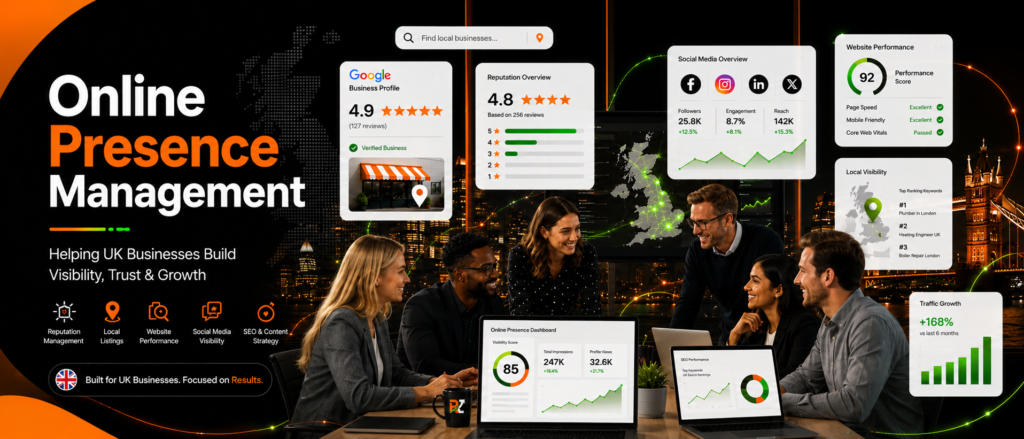
The way customers discover, evaluate, and trust businesses has been completely rewritten in 2026. A static website and a few social media profiles no longer constitute a competitive digital footprint. Instead, every search query, review snippet, social comment, and brand mention weaves together a dynamic perception of your business across dozens of fragmented channels. Online Presence Management Services exist to unify these touchpoints into a deliberate, measurable strategy.
Fragmented digital tactics are among the biggest drains on marketing budgets. A company might invest heavily in paid ads while its organic listings are riddled with outdated information and ignored complaints. Or it might publish excellent blog content that never ranks because technical SEO issues block search engines from indexing the pages. Managing online presence smartly means shifting from siloed execution to an agile, data-driven system that adapts to algorithm updates, user behavior shifts, and emerging platforms in near real time. Smart management connects on-site optimization, off-site reputation, content distribution, and conversion analytics into a continuous feedback loop. The result is not just higher traffic, but qualified traffic that converts, and a brand narrative that builds lasting authority rather than temporary visibility.
The gap between simply being online and strategically dominating your digital niche has widened to a chasm. Businesses that treat their online presence as a checklist item find themselves losing ground to competitors who treat it as a core business asset. Slow load times, inconsistent NAP (Name, Address, Phone) data across directories, unaddressed negative reviews, and generic AI-generated content all send negative quality signals to both search engines and human visitors. Over time, these signals compound, depressing organic rankings, shrinking conversion rates, and making recovery exponentially more expensive. The cost of unmanaged digital decay is not theoretical a single page one ranking drop can slash organic traffic by over 50%, and rebuilding lost trust often costs five to seven times more than maintaining it.
Beyond corporate brands, the explosion of personal search and the blurring of professional and personal identities have made individual reputation a critical business factor. Executives, consultants, healthcare providers, and creators are all subject to the same scrutiny once reserved for large companies. Online Reputation Management for Individuals safeguards careers, attracts speaking engagements, and strengthens the credibility of the businesses they represent.
A negative news article, an ill-advised social post, or even a mistaken identity can dominate search results for years, forming a permanent first impression. Proactive personal reputation management monitors search engine results pages (SERPs) for names, builds authoritative positive content that ranks above any potential negatives, and establishes a controlled narrative that reflects genuine expertise.
What is online presence management?
Online presence management is the systematic oversight of every digital channel that shapes how a brand or individual is perceived and found. It is not a single task but a strategic discipline that fuses technical website operations, search engine visibility, content publishing, social media engagement, review platform activity, local business listings, public relations, and even emerging touchpoints like voice assistant results and AI-generated search overviews.
At the technical level, it involves ensuring a website loads in under two seconds on mobile devices, passes Core Web Vitals assessments, and maintains a clean information architecture that lets search crawlers access every important page. It means configuring structured data so that review stars, product prices, and event dates appear directly in search results. It demands an understanding of semantic search how Google’s algorithms interpret entities, relationships, and user intent so that content is not just keyword-stuffed but mapped to the full scope of a topic. It also requires continuous monitoring of server uptime, security certificates, and broken links that degrade trust and rankings.
From a content and engagement perspective, online presence management governs voice consistency across a brand’s blog, social channels, email newsletters, and community interactions. It orchestrates publishing schedules so that content resonates with seasonal trends and user needs. It manages the feedback loop between customer service inquiries on social media and the public-facing brand image. Reputation management functions within this discipline analyze sentiment, generate review responses that satisfy both the customer and search algorithms, and build a body of positive content that pushes down unfavorable mentions.
In practice, effective online presence management operates as a central nervous system. When a review is posted, the right team is alerted, a considered response is crafted, and insights from the review feed back into product or service improvements. When a competitor launches a new content campaign, the presence manager adjusts SEO and content strategies to protect market share. When a core algorithm update shakes up rankings, a rapid audit identifies affected areas and initiates recovery steps. The goal is not merely to exist online but to actively shape perception, capture demand, and convert visibility into measurable business outcomes.
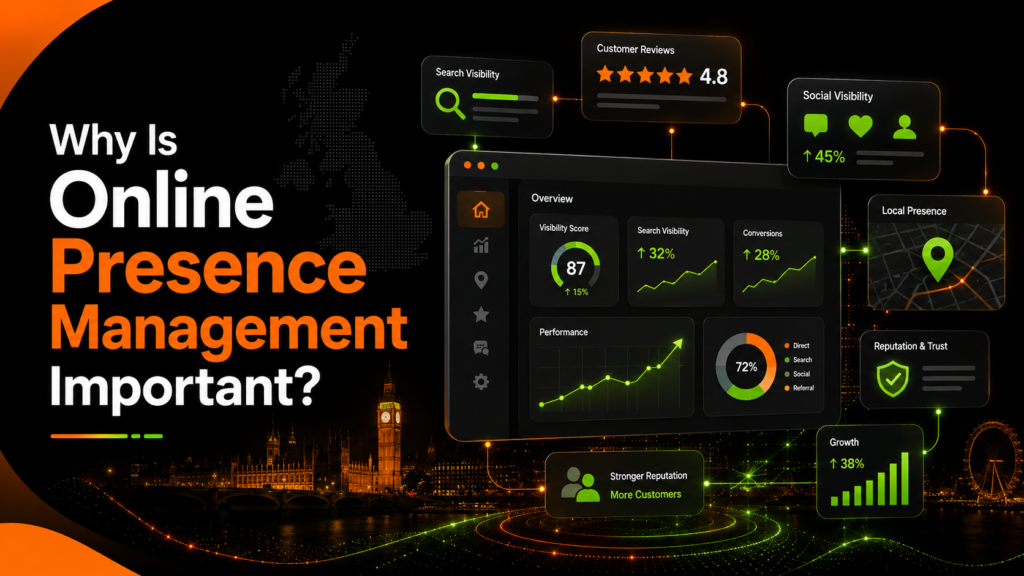
Why Is Online Presence Management Important?
Building Brand Awareness
Today’s buyer journey often begins with a typed question, a voice command to a smart device, or a scroll through an AI-curated feed. If your business does not appear in the zero-click answers, local map packs, video carousels, or discussion forums that surface for those queries, you are invisible to a massive segment of your audience. Online presence management ensures your brand occupies the full spectrum of search real estate from traditional blue links to featured snippets, “People Also Ask” boxes, image results, and short-form video platforms. It extends to being present on the review sites, industry directories, and social platforms your specific customers use to validate purchasing decisions. This multi-channel visibility repeatedly exposes prospects to your brand, building recognition and recall before they ever visit your website.
Increasing Credibility and Trust
Credibility in 2026 is algorithmically signaled and human-judged simultaneously. When a business’s website displays a valid SSL certificate, fast mobile experience, clear author bylines with verifiable credentials, and accurate contact information, both search engines and visitors assign higher trust. Online presence management ensures these trust signals are in place and up to date. Beyond technical indicators, it manages social proof. Review volume, star ratings, and thoughtful responses to feedback directly impact conversion. A consistent brand voice across a LinkedIn article, a YouTube tutorial, and a Google Business Profile post reassures customers that they are dealing with a stable, reliable organization. In an era of AI-generated spam, demonstrable human expertise and real-world validation become powerful differentiators.
Generating More Leads and Sales
A well-managed online presence does not just generate traffic; it generates the right traffic. By aligning content with high-intent search queries those where users are actively looking to buy, hire, or sign up businesses attract visitors primed to convert. Integrating clear calls-to-action, optimized landing pages, and retargeting pixels turns casual browsers into leads. Presence management also connects the dots between channels: a user might discover your brand through a local map listing, read a detailed case study on your blog, and finally convert after seeing a retargeted social ad. Tracking these multi-touch journeys and optimizing each step can dramatically lower customer acquisition costs compared to single-channel efforts.
Improving Customer Engagement
Engagement is not just about likes and shares; it is about fostering a community that advocates for your brand. Online presence management monitors social media comments, forum mentions, and direct messages, enabling swift, personalized responses. When a customer shares a success story or expresses a frustration, real-time engagement turns isolated interactions into public demonstrations of your commitment to service. Actively participating in niche communities, hosting Q&A sessions, and sharing user-generated content humanizes the brand and strengthens emotional connections that drive repeat business and referrals.
Gaining a Competitive Advantage
Many businesses still neglect foundational aspects like local listing accuracy, mobile page speed, or review management. By mastering these areas, you capture market share that competitors leave on the table. Moreover, proactive presence management spots competitor weaknesses such as unanswered negative reviews or content gaps and exploits them. A competitor’s declining Google Business Profile engagement, for instance, is an opportunity to ramp up your local content and review generation, pulling local customers into your orbit. The competitive advantage compounds: higher engagement leads to stronger ranking signals, which yield more visibility, further engagement, and a widening moat.
Why online presence is essential for PR teams
Public relations has evolved far beyond press releases and media pitching. A brand’s reputation is now sculpted in real time across Google search results, social media threads, review platforms, and journalist requests on networks like HARO. For PR teams, online presence management is the infrastructure that detects brewing crises, amplifies positive narratives, and ensures that every communication aligns with the digital assets customers actually encounter.
When a journalist researches a company, their first action is a Google search. If the SERP displays outdated leadership bios, negative reviews on page one, or a dormant blog, the story’s angle shifts before a PR representative ever makes contact. Conversely, a meticulously maintained online presence puts forth expert commentary, recent accolades, and thought leadership content that positions the brand as an authoritative source. PR teams that collaborate with presence managers can quickly publish owned content to support a media push, landing additional organic coverage as search engines index the coordinated message.
Crisis communication is where this intersection becomes most critical. A single viral customer complaint can dominate search results within hours. Online presence management tools monitor brand mentions, sentiment shifts, and sudden ranking changes, triggering alerts that allow PR teams to respond before a narrative hardens. A calm, empathetic response published on the same platform where the complaint originated and supported by updated website messaging prevents a negative blip from becoming a permanent reputation scar. Post-crisis, presence management rebuilds the digital landscape by publishing a series of positive, authoritative assets that push down lingering negative coverage.
Furthermore, digital PR is now a primary link-building and authority-building channel. When PR secures coverage in a top-tier publication, the backlink from that article boosts domain authority. Presence management ensures the technical SEO value of those links is maximized the right pages receive authority, internal linking distributes equity, and indexed articles contribute to the brand’s overall E-E-A-T (Experience, Expertise, Authoritativeness, Trustworthiness) profile. Without this integration, PR wins become fleeting headlines instead of permanent ranking assets.
Common challenges and how to overcome them
Fragmented data and disconnected platforms
Many businesses manage their website, social media, reviews, and analytics in separate tools that do not communicate. This fragmentation obscures the full customer journey and makes it impossible to attribute outcomes accurately. The solution is to implement a centralized presence management platform or service that aggregates data into unified dashboards. Connecting Google Analytics 4, Search Console, social insights, and review platforms through API integrations or a professional service layer enables a single source of truth for decision-making.
Lack of in-house expertise
Small and mid-sized businesses often assign online presence tasks to a marketing generalist or a busy owner. They lack the deep technical SEO knowledge, content strategy skills, and reputation management experience needed to compete. Hiring a full team is cost-prohibitive. Partnering with a specialized online presence management agency injects senior-level strategy and execution without the overhead. The agency model provides access to SEO specialists, content writers, social media managers, and reputation analysts who coordinate efforts under a unified strategy.
Algorithm volatility
Google rolls out thousands of algorithm updates per year, and social media platforms continuously tweak their feed algorithms. A strategy that works today can backfire tomorrow. Overcoming this requires an approach built on genuine quality, not algorithmic loopholes. Focus on delivering excellent user experience, original research-backed content, and authentic engagement. Pair this with continuous monitoring of industry news and ranking fluctuations. When an update hits, run a differential diagnosis: compare pages that gained versus lost traffic to identify patterns, then adjust content depth, page experience, or entity associations accordingly.
Negative reviews and reputation attacks
Bad reviews sting, and the instinct to ignore or delete them backfires publicly and algorithmically. The better approach is a calm, empathetic reply that addresses the specific complaint, offers a resolution path, and demonstrates accountability. When fake reviews or smear campaigns appear, document the violations, report them through official channels, and simultaneously publish a volume of authentic positive content that dilutes the impact. Legal threats should be a last resort, as they often amplify the Streisand effect.
Multi-location brand consistency
Franchises, retail chains, and service-area businesses with multiple locations struggle to keep their name, address, phone number, business hours, and service descriptions identical across hundreds of directories. Inconsistency confuses search engines, weakens local pack rankings, and frustrates customers. Local listing management tools and services that push updates to dozens of directories from a single dashboard resolve this. Regular audits catch discrepancies introduced by third-party aggregators or manual edits, protecting local ranking strength.
Why Online Presence Requires Ongoing Optimisation
Digital decay is relentless. Websites that stand still see their page speed metrics degrade as hosting environments become outdated, plugins accumulate bloat, and new image formats overtake legacy files. Content that once ranked can become stale as competitors publish fresher, more comprehensive resources and search intent shifts. Google’s Core Web Vitals thresholds evolve, and what passed as “good” last year may be “needs improvement” today, directly impacting rankings. Backlinks rot when referring domains remove pages or change their linking structure, silently eroding domain authority.
User expectations evolve just as quickly. Mobile-first indexing means that a website’s mobile experience is now the primary version Google evaluates. If a business has not optimized for tap targets, font sizes, and interstitial usage on smartphones, it underperforms even if desktop metrics are strong. Voice search and AI-assisted browsing are changing query structures; people now ask full conversational questions rather than typing fragmented keywords. Content that fails to address these long-tail, natural-language queries misses a growing traffic segment.
Competitors actively invest in their own online presence. Every month a business delays optimization, a rival is publishing a better pillar page, acquiring high-authority backlinks, or ramping up review volume. The gap compounds, making it progressively harder and more expensive to catch up. The cost of unplanned downtime further underscores the need for proactive management. A hosting outage that takes a site offline during peak hours not only costs immediate sales but can cause Google to temporarily de-index pages, triggering ranking turbulence that takes weeks to stabilize.
Continuous optimization also allows for intelligent experimentation. A/B testing headline structures, meta descriptions, and call-to-action placements yields incremental conversion rate improvements that add up dramatically over a year. Heatmap analysis and session recordings reveal friction points users encounter, informing UX changes that reduce bounce rates and increase dwell time both positive engagement signals. The businesses that treat online presence as a living, breathing asset rather than a set-it-and-forget-it project capture compound returns.
Components of a Strong Online Presence Management
Website Optimization and User Experience
The website is the hub of all online presence activity. Technical foundations include a secure HTTPS connection, fast server response times, efficient browser caching, optimized image delivery through next-gen formats like WebP and AVIF, and a clean code structure free of render-blocking JavaScript. On mobile, the experience must be seamless: readable text without zooming, adequately spaced tap targets, and no intrusive pop-ups that obscure content. Beyond speed, the site architecture must be logically flat important pages no more than a few clicks from the homepage with clear internal linking that distributes link equity and guides users toward conversion points. Accessibility compliance (WCAG 2.2) is now a reputational and legal consideration, as well as a ranking factor in certain jurisdictions.
Search Engine Optimization (SEO)
Modern SEO extends well beyond keywords. It encompasses entity optimization, where search engines understand that your brand is a distinct entity connected to people, places, and related topics. Schema markup (structured data) defines exactly what each page contains, earning rich results. Technical SEO ensures crawl budget is used efficiently; XML sitemaps are accurate; canonical tags prevent duplicate content issues; and hreflang tags direct international audiences. On-page SEO maps primary and semantically related terms to title tags, headings, and body content in a user-first way. Off-page SEO revolves around earning links from authoritative, topically relevant sources not through manipulative tactics, but through digital PR, original research, and genuinely useful tools or resources that others want to cite. AI-generated search overviews are now a major SERP feature; optimizing for these requires concise, fact-dense content that directly answers questions and can be easily extracted by large language models.
Social Media Presence
A scattered social presence wastes effort. Strong management identifies the two or three platforms where the target audience actively seeks professional or purchase-related information. For B2B, LinkedIn and YouTube may dominate; for visual consumer brands, Instagram and TikTok. The key is platform-native content short-form vertical video for Reels and TikTok, long-form thought leadership for LinkedIn articles, and community building in niche groups or Discord servers. Social profiles must be fully filled out with consistent branding, up-to-date contact details, and links back to the core website. Social listening tools monitor brand mentions and relevant hashtags, enabling the business to join conversations organically. Engagement metrics like saves and shares outweigh vanity metrics like follower counts; presence management prioritizes sparking meaningful interactions that signal relevance.
Online Reputation Management
Reputation management is a continuous cycle of monitoring, responding, and building. It covers Google reviews, industry-specific review platforms (Healthgrades, G2, Trustpilot), social media comments, and even discussions on Reddit or Quora. Automated alerts flag new mentions instantly. Response protocols ensure that every positive review receives a personalized thank-you, while negative reviews are addressed with a calm, solution-oriented reply within hours not days. Beyond reactive management, proactive reputation building involves generating a steady stream of authentic reviews from happy customers, publishing case studies and testimonials on the website, and creating a body of positive content that occupies the first page of branded search results. For individuals, this extends to optimizing personal websites, LinkedIn profiles, and contributed articles so that a Google search returns a professionally curated snapshot.
Content Marketing
Content is the engine of organic visibility and authority. A strategic content plan moves beyond random blog posts to a topic cluster model: comprehensive pillar pages covering core subjects, supported by cluster articles that explore subtopics in depth and link back to the pillar. Content must satisfy E-E-A-T signals. This means including expert author bios with credentials, citing original data or firsthand experience, and keeping content freshly updated to reflect current information. Formats diversify into video tutorials, infographics, podcasts, and interactive tools based on audience preference. Content distribution is equally important sharing across social channels, email newsletters, and relevant communities drives initial traffic and engagement signals that help indexing and ranking.
Business Listings and Local SEO
For businesses serving specific geographic areas, local SEO is non-negotiable. A fully optimized Google Business Profile (GBP) drives map pack visibility: accurate category selection, comprehensive service descriptions, high-quality photos, weekly posts, and a steady flow of new reviews. Beyond Google, consistency across Apple Maps, Bing Places, Yelp, and industry-specific directories is essential. Local page content on the website, including city-specific landing pages with genuine local information and embedded maps, supports organic local ranking. NAP consistency across the web is a foundational trust signal; even a minor abbreviation difference between “St.” and “Street” can create confusion that depresses local search performance.
Email Marketing and Customer Engagement
Email remains a channel owned entirely by the brand, immune to algorithm shifts. An online presence strategy integrates email capture throughout the digital footprint via lead magnets on the website, newsletter sign-ups on social media, and even QR codes on physical materials that point to a landing page. Segmented email sequences nurture leads based on their behavior and interests, moving them from awareness to consideration to purchase. Automated win-back campaigns re-engage dormant customers. The content shared via email reinforces the same brand voice and value propositions present across all other channels, strengthening a cohesive presence. Engagement data from email (open rates, click-throughs, conversions) feeds back into audience insights that refine broader content and messaging strategies.
Common Online Presence Management Mistakes to Avoid
Ignoring Negative Reviews
When businesses bury their heads in the sand, negative reviews fester and dominate search results. Worse, they go unanswered, signaling to potential customers that the business does not care. A single detailed negative review can turn away dozens of high-intent prospects. Avoidance also prevents internal learning; negative feedback often highlights fixable operational issues. The smarter path is to publicly acknowledge the feedback, apologize for the specific shortcoming, and take the resolution offline, then follow up publicly with the outcome if appropriate.
Inconsistent Branding
Different profile pictures, mismatched color schemes, varying tone of voice, and contradictory mission statements across platforms confuse audiences and weaken brand recall. Search engines also cross-reference brand signals. Inconsistency in NAP data or business categories dilutes local ranking power. Brand guidelines must be documented and enforced across every digital outpost. A presence management service conducts regular audits to catch and correct deviations before they cause damage.
Neglecting Mobile Optimization
In 2026, the majority of web traffic and search queries originate from mobile devices. Google’s mobile-first indexing means the mobile version of a site is the primary basis for ranking. Yet many businesses still design for desktop first, resulting in tiny text, overlapping elements, slow load times on cellular connections, and frustrating checkout processes. Neglecting mobile optimization is equivalent to locking the front door on half your customers. The fix starts with rigorous mobile testing, responsive design that adapts intelligently, and prioritizing speed on 4G/5G networks.
Posting Without a Content Strategy
Random acts of publishing — a blog post when inspiration strikes, a social update only during sales create no momentum. Audiences learn to ignore erratic brands. Search engines prefer sites that demonstrate consistent topical authority over time. A content calendar mapped to business goals, seasonal trends, and customer pain points ensures every piece of content serves a strategic purpose. It also allows for resource planning, repurposing content across formats, and measuring performance against a coherent baseline.
Failing to Monitor Analytics
Operating without analytics is navigating blind. Without data on organic traffic trends, conversion paths, bounce rates, and audience demographics, businesses cannot diagnose declines or double down on winners. Many companies install analytics but never regularly review the data or set up meaningful goal tracking. The fix is to establish a monthly performance dashboard that ties directly to business KPIs such as lead form submissions, phone calls from the website, or e-commerce revenue and to schedule disciplined review sessions where the team asks “What’s working, what’s not, and what will we change?”
Best Tools for Online Presence Management
Google Business Profile
The linchpin of local presence. Beyond basic listing, use the Q&A feature to pre-populate common questions, post weekly updates with offers or events, upload geo-tagged photos, and engage with the messaging feature. Regularly check the “insights” section to see what search queries drive profile views and directions.
Google Analytics 4
GA4’s event-based model tracks user interactions across web and app. Set up custom events for key actions (form submissions, phone clicks, PDF downloads). Use the exploration reports to map multi-touch conversion paths and understand which presence channels assist rather than just last-click conversions. Connect GA4 to Google Search Console for unified search query analysis.
Google Search Console
The essential tool for understanding search performance. Monitor click-through rates by query, identify pages with high impressions but low clicks (opportunities to improve title tags and meta descriptions), submit sitemaps, and review indexing issues. The Core Web Vitals report flags poor page experience that hurts rankings.
SEMrush
A comprehensive suite for competitive research, keyword gap analysis, rank tracking, and site auditing. Use the domain vs. domain comparison to see exactly which keywords competitors rank for that you do not. The content marketing toolkit identifies trending topics and questions your audience asks, fueling content strategy. The backlink audit tool flags potentially toxic links that could penalize your site.
Ahrefs
Renowned for its backlink crawler, Ahrefs uncovers who links to your competitors and on what pages, revealing link-building opportunities. The content explorer function surfaces high-performing content in any niche, showing the backlinks and organic traffic it attracted. Use it to reverse-engineer success and identify content gaps you can fill with superior resources.
Hootsuite
Hootsuite enables scheduling, monitoring, and engagement across multiple social profiles from one dashboard. Custom streams track brand mentions, hashtags, and competitor activity. The analytics module generates shareable reports that show how social media contributes to broader presence goals, such as traffic referrals and audience growth trends.
Buffer
Buffer’s simplicity makes it ideal for teams that want streamlined scheduling with a clean interface. It supports post customization per platform, so a single message can be tailored for Instagram, LinkedIn, and Twitter. Engagement features let community managers reply to comments directly, and analytics reveal best posting times and top-performing content formats.
Best Practices for Boosting Online Presence Management
Create a Professional Website
Your website must convey credibility within three seconds. That means a clean, modern design, consistent with brand colors and fonts, and prominently displaying trust signals like security badges, client logos, or certifications. Ensure the homepage immediately communicates what you do, for whom, and what action to take next without clutter. All pages must load fast, be free of broken elements, and work flawlessly across every browser and device. A professional site also includes a privacy policy, accessible terms of service, and clear contact information to meet both legal requirements and user expectations.
Optimize for Search Engines
Start with deep keyword research that segments terms by intent: informational, commercial, transactional, and navigational. Map each keyword cluster to a specific page. Optimize title tags to be compelling and include primary terms near the beginning. Write meta descriptions that accurately summarize the page while enticing clicks. Use header tags hierarchically. Implement schema markup for articles, products, FAQs, and local business information. Optimize images with descriptive alt text and compressed file sizes. Maintain an internal linking structure that guides both users and crawlers to your most important pages.
Publish High-Quality Content Regularly
High-quality content satisfies user intent better than any competing piece. It is original containing unique data, expert insights, or case studies not found elsewhere. It is comprehensive without being padded, answering secondary questions the user will likely have. It is scannable, with short paragraphs, descriptive subheadings, and supporting visuals. Publishing regularly does not mean daily; it means a sustainable cadence that builds topical authority over time. One exceptional, well-researched piece per week outperforms five shallow AI-generated posts. Always attribute expert contributors and cite primary sources to strengthen E-E-A-T.
Maintain Active Social Media Profiles
Active does not mean omnipresent. It means showing up consistently on chosen platforms with content that fits each environment. Respond to comments and messages promptly, ideally within a few hours during business days. Participate in relevant conversations, share user-generated content, and highlight customer success. Use stories and live video to humanize the brand. Each profile should link back to your website and, where possible, to other social profiles to create a connected brand ecosystem.
Monitor and Respond to Reviews
Designate a team member or service to monitor all major review platforms daily. Craft response templates for common scenarios to ensure consistency, but personalize every reply. For positive reviews, express genuine gratitude and mention something specific the customer said. For negative reviews, acknowledge the issue without being defensive, apologize for the specific experience, and offer a direct line to resolve the matter. Never demand a review be taken down unless it violates platform policy. The public sees how you handle criticism more than the criticism itself.
Build Authoritative Backlinks
Focus on earning links, not building them through spam. Create linkable assets: original industry surveys, definitive guides, free tools, interactive calculators, or data visualizations that other sites want to reference. Engage in digital PR by connecting journalists on platforms like Qwoted with expert commentary. Write guest articles for respected publications in your niche, with links that provide genuine contextual value. Reclaim unlinked brand mentions by politely asking authors to add a hyperlink. Disavow truly toxic backlinks only after manual review, as overuse of the disavow tool can harm a healthy profile.
Track Performance Metrics
Set up a live dashboard that pulls in data from all core platforms. Track organic sessions, bounce rate, goal completions, keyword position movements, review volume and sentiment, social engagement rate, and email click-through rates. Establish monthly review meetings where the team analyzes trends, identifies anomalies, and documents action items. Use annotation features in analytics to mark algorithm updates, major campaigns, or site changes, so you can correlate actions with outcomes. Performance tracking closes the loop between effort and result, allowing for constant refinement.
How to Measure Online Presence Success
Organic Traffic Growth
Sustained, upward trending organic sessions signal that search visibility is expanding and content is attracting the right audience. Measure not just total traffic but segment by landing page to see which topics are gaining traction. Compare branded vs. non-branded organic traffic; growth in non-branded traffic indicates that your presence is reaching new audiences who did not already know your name.
Keyword Rankings
Track target keyword clusters, not just individual terms. Monitor how many keywords rank in the top three, top ten, and top twenty positions over time. Pay special attention to high-intent commercial and transactional queries. A rising number of featured snippet and “People Also Ask” occupancies shows your content is being recognized as authoritative and well-structured.
Brand Mentions
Use media monitoring tools to track how often your brand is mentioned across the web, including news sites, blogs, forums, and social platforms. Measure both volume and sentiment. An increase in positive, unlinked mentions indicates growing mindshare. Calculate the rate at which you convert unlinked mentions into linked citations a direct metric of proactive presence management.
Social Engagement Metrics
Look beyond follower counts. Track shares, saves, comments, and link clicks per post. Engagement rate per impression or per follower is a truer measure of content resonance. Monitor the growth of direct messages and inbound social inquiries; these often represent high-intent prospects using social as a customer service channel.
Conversion Rates
Ultimately, online presence must drive business outcomes. Track macro-conversions (sales, quote requests, booked appointments) and micro-conversions (email sign-ups, whitepaper downloads, video views). Analyze conversion rates by traffic source and landing page. A high-traffic page with a low conversion rate signals a disconnect between user expectation and page content, or a weak call-to-action a clear optimization priority.
Customer Reviews and Ratings
Average star rating is a snapshot, but trend matters more. Monitor review velocity how many new reviews appear per month and sentiment trends. A growing volume of recent, positive reviews lifts local rankings and consumer trust. Track the percentage of negative reviews successfully resolved, as reflected in updated ratings or follow-up comments.
Online presence management key benefits
Consolidating online presence efforts under a strategic management framework delivers measurable gains that siloed tactics cannot match:
-
Up to 40% reduction in customer acquisition cost by prioritizing organic channels that compound over time, rather than renting visibility through ads that vanish when budgets stop.
-
60% faster response to reputation threats through real-time monitoring and predefined escalation protocols, preventing viral negativity from causing permanent brand damage.
-
2–3x improvement in conversion rates from landing pages when UX signals, page speed, and message alignment are systematically optimized against user intent.
-
50% greater organic search visibility within 12 months, as technical SEO health, topical authority, and consistent local signals lift rankings across entire keyword clusters.
-
80% higher review volume and rating consistency when review generation is automated and integrated into the customer journey, directly influencing local pack and trust-based purchase decisions.
-
Significant operational efficiency gains marketing teams reclaim 20+ hours per month previously lost to manual reporting, disjointed tools, and reactive firefighting, reallocating that time to strategic growth initiatives.
-
Sustained competitive defense as the brand’s digital moat widens: cumulative authority, backlinks, and positive content make it progressively harder for new entrants to displace incumbents.
Future Trends in Online Presence Management
AI-Powered Search and SEO
Generative AI now synthesizes answers directly on search result pages, reducing clicks to traditional websites for simple queries. This shifts SEO focus toward appearing as a cited source within AI overviews. To do this, content must be structured in clear, factual blocks with concise definitions and cited data. At the same time, AI-powered tools are revolutionizing keyword research, content gap analysis, and technical audits, enabling presence managers to identify opportunities and anomalies at a scale previously impossible. The winners will be those who use AI to enhance genuine human expertise, not to flood the web with undifferentiated low-value content.
Voice Search Optimization
With smart speakers and voice assistants embedded in cars, appliances, and wearables, voice queries are a daily habit for millions. Voice searches are longer, more conversational, and often local (“find a plumber near me open now”). Optimization means crafting FAQ pages that use natural language questions and answers, ensuring Google Business Profiles are completely filled out, and earning featured snippets that voice assistants read aloud as the single answer. Website schema for speakable content will become a differentiator.
Personal Branding
As trust in faceless corporations erodes, the personal brands of founders, executives, and key employees increasingly influence corporate reputation. An executive with a strong, positive online presence acts as a trust anchor for the entire organization. Presence management will involve coaching leaders on their social media activity, ghostwriting thought leadership, and securing podcast appearances and speaking engagements that build individual and collective authority.
E-E-A-T and Authority Building
Google’s emphasis on Experience, Expertise, Authoritativeness, and Trustworthiness continues to intensify, especially in YMYL (Your Money or Your Life) niches like finance, health, and legal services. Demonstrating firsthand experience through detailed case studies, author pages with verifiable credentials, and transparent sourcing is mandatory. Building authority requires consistent coverage of a topic over time, corroborated by links from established authorities in the same field. Online presence management will spend increasing resources on proving, not just claiming, expertise through original research, expert reviews, and multi-format content that signals depth.
Omnichannel Marketing
Customers now expect a seamless transition between channels. A user might see an ad on a connected TV, search for the brand on mobile, read reviews on a third-party site, and complete a purchase on a desktop all within an hour. Online presence management must ensure branding, messaging, pricing, and offers are consistent across every channel, and that attribution models capture these complex paths. Omnichannel strategies will integrate digital presence with offline experiences, such as AR try-ons and in-store QR code interactions, demanding that online content synchronizes with physical reality.
How Professional Online Presence Management Services Can Help
Most business owners and marketing teams are stretched thin. The technical demands of modern SEO, the relentless need for fresh, authoritative content, the vigilance required to guard a reputation, and the complexity of measuring cross-channel performance exceed what a generalist can deliver. Professional services bridge this gap with a team of specialists working from a unified playbook.
The engagement typically begins with a comprehensive audit. Experts crawl the website for technical issues, analyze competitor online footprints, map keyword landscapes, and assess the sentiment and completeness of reviews and local listings. This uncovers the specific hidden problems orphan pages bleeding authority, incorrect schema causing rich result disqualification, a critical missing location page that generic tools miss.
From the audit, a custom presence strategy emerges. It assigns clear priorities: fixing architecture before publishing new content, resolving NAP inconsistencies before running local ads, building a positive content buffer before a known seasonal reputation risk. The service then executes across all components simultaneously an SEO specialist optimizes page structure, a content team publishes expert-led articles, a social media manager builds community engagement, and a reputation analyst monitors and responds to reviews. All activities track back to a centralized dashboard and monthly performance review.
The quantifiable difference is speed and reduced risk. A business attempting to manage presence alone might take 18 months to fix technical debt and begin seeing ranking improvements; a professional service with established processes and priority tools can compress that timeline to six to nine months. Missteps like choosing the wrong disavow strategy, accidentally blocking important pages in robots.txt, or responding emotionally to a review are avoided. Instead, the business gains a partner with battle-tested protocols who has navigated similar challenges across industries.
Beyond execution, professional services offer accountability and transparency. Regular reports show exactly how organic traffic, keyword positions, lead volume, and review sentiment have changed. Strategy calls interpret the data and adapt the plan. The business owner shifts from firefighter to overseer, free to focus on operations while the online presence systematically accrues authority and drives sustainable growth.
Conclusion: Building a Strong and Lasting Online Presence
An online presence is no longer a digital brochure. It is a living ecosystem that directly impacts revenue, reputation, and resilience. The businesses that stand out in 2026 are those that treat this ecosystem as a strategic asset investing in professional management that unifies technical excellence, valuable content, authentic engagement, and proactive reputation defense. They build compound advantages that competitors cannot easily replicate: a library of expert content that earns trust, a constellation of local listings that map perfectly, a stream of recent positive reviews that tip purchase decisions, and a web of authoritative backlinks that lifts the entire domain.
The journey starts with a clear-eyed assessment of current gaps and a commitment to ongoing optimization. Whether you partner with a dedicated service or build an internal team with the right expertise, the principles remain the same: consistency, quality, responsiveness, and measurement. In a digital landscape saturated with AI noise and fleeting attention, the brands that last are those that build a presence rooted in genuine human value and manage it with disciplined, forward-looking care.
Online Presence Management FAQs
What is online presence management?
Online presence management is the ongoing strategic oversight of every digital channel that shapes how your brand is discovered and perceived. It goes far beyond posting on social media. It involves ensuring your website loads fast on mobile, securing it with HTTPS, fixing broken links, and structuring data so search engines display rich results. It means managing your Google Business Profile, responding to reviews across multiple platforms, and publishing content that satisfies both user intent and Google’s E-E-A-T requirements. This discipline unifies SEO, content marketing, social media engagement, local listings, and reputation monitoring into a coordinated system that builds visibility and trust.
Why is online presence important?
Your online presence is the first and often only impression you make on a potential customer. When someone searches for your service, they see your website, reviews, star rating, social activity, and local listing details all at once. If any piece looks neglected or inconsistent, they will choose a competitor within seconds. A strong, managed presence boosts organic traffic, builds credibility faster than advertising alone, and generates high-intent leads from people actively looking for what you offer. It also acts as your reputation defense, ensuring you control the narrative rather than leaving it to chance.
How can I improve my online presence?
Start with an honest audit of where you stand. Check your website’s mobile speed using Google PageSpeed Insights and fix anything that slows it below two seconds. Claim and completely fill out your Google Business Profile with accurate hours, services, and photos. Start requesting reviews from happy customers on a consistent basis, not in bursts. Create content that answers the exact questions your customers type into search engines, based on keyword research. Ensure your name, address, and phone number are identical across every directory. Finally, set up Google Analytics 4 and Search Console to measure progress instead of guessing.
What does a Digital Presence Manager do?
A Digital Presence Manager oversees the technical, content, and reputation elements that form your brand’s footprint online. They conduct technical SEO audits to find and fix crawling errors, optimize site architecture, and implement schema markup. They coordinate content strategy, ensuring blog posts and videos target the right keywords and showcase genuine expertise. They monitor review platforms daily and craft responses that protect your reputation while addressing customer concerns. They also synchronize social media activity, track competitor moves, and adjust tactics based on performance data. Essentially, they ensure no aspect of your digital identity degrades or gets outpaced.
What are the benefits of online presence management?
The direct benefit is a steady increase in qualified organic traffic and leads without paying for every click. Businesses typically see reduced customer acquisition costs as organic visibility compounds. Reputation monitoring and rapid response prevent isolated complaints from going viral and causing permanent brand damage. Consistent branding and accurate listings build trust that increases conversion rates. Operations gain efficiency because fragmented tools and reactive firefighting are replaced by a unified strategy and clear performance dashboards. Over time, a well-managed presence creates a competitive moat that is difficult and expensive for rivals to breach.
Why are online reviews important?
Reviews serve as instant social proof and a major local search ranking signal. Before contacting you, prospects read recent reviews to assess reliability, quality, and how you handle problems. A high star rating and a steady flow of new reviews increase click-through rates from search results. Google’s algorithm interprets review volume, recency, and sentiment when deciding which businesses to show in the local map pack. Moreover, the way you respond publicly to criticism shows potential customers your values more than any marketing message can. A thoughtful, solution-oriented reply often converts a detractor into a loyal advocate while impressing onlookers.
What tools help manage online presence?
Essential tools cover analytics, SEO, social media, and reputation monitoring. Google Analytics 4 and Google Search Console provide foundational data on traffic, user behavior, indexing status, and search performance. Google Business Profile is the control center for local visibility. SEO platforms like SEMrush and Ahrefs reveal keyword gaps, competitor strategies, and technical site issues. Hootsuite or Buffer streamlines social scheduling and engagement across platforms. For reviews, a reputation management tool that aggregates alerts from Google, Yelp, and industry-specific sites ensures nothing slips through. The key is integrating insights from these tools into a single, reviewable performance dashboard.
How long does it take to build an online presence?
Building a meaningful, competitive online presence is a continuous process, not a one-time project. You can see initial improvements from fixing critical technical errors and claiming local listings within a few weeks. Achieving page-one rankings for competitive keywords and earning a strong review profile typically takes six to twelve months of consistent effort. True authority where your brand is recognized as a go-to resource and ranks for thousands of relevant terms builds over years. The timeline depends on your starting point, industry competition, and the consistency of your content and optimization efforts. Expect gradual gains that accelerate as authority compounds.
How do I increase my online visibility?
Focus on appearing in every type of search result your customers use. Optimize your website and content to earn featured snippets, “People Also Ask” boxes, and image/video carousels, not just blue links. Build out comprehensive pillar pages that cover core topics deeply, supported by cluster articles. Grow your Google Business Profile with weekly posts, new photos, and fresh reviews to dominate local searches. Create original data or research that journalists and bloggers will link to, boosting domain authority. Be present and active on the specific social platforms where your audience seeks recommendations. Consistency across all these channels signals relevance and authority to search engines.
How can I hire the best online presence management firm?
Look for a firm that starts with an in-depth audit, not a generic proposal. They should ask detailed questions about your business goals, customer journey, and past challenges. Examine their own online presence; a firm that cannot rank its own site or maintain a strong review profile lacks credibility. Request case studies with specific performance metrics, like percentage growth in organic traffic or leads, not just activity reports. Ensure they have specialists in technical SEO, content strategy, and reputation management working together, rather than relying on a single generalist. Finally, insist on clear, recurring reporting that ties their work directly to your business outcomes, not vanity metrics.