
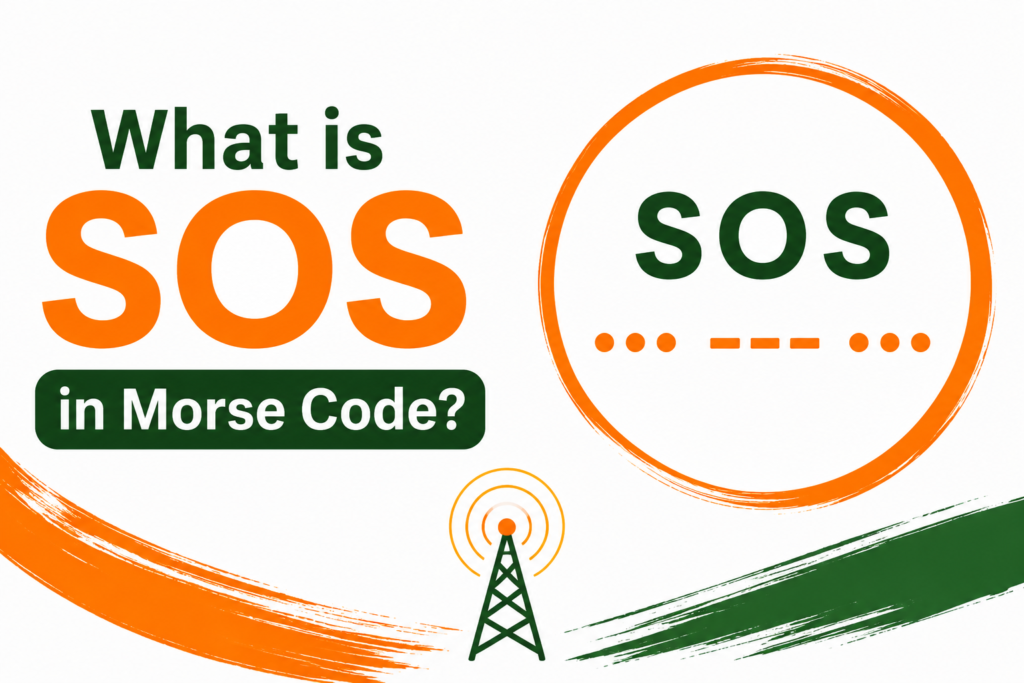
What is SOS in Morse Code?
The SOS signal is recognized across the globe as the ultimate call for help. When sound fails, when visibility drops, and when modern devices are out of reach, the simple pattern of three dots, three dashes, and three dots can save a life. This comprehensive guide explores the origin, representation, proper use, and enduring value of SOS in Morse code. Whether you are an outdoor enthusiast, a sailor, a prepper, or simply a curious learner, you will find everything you need to master this timeless emergency signal.
Table of Contents
How to Write SOS in Morse Code (··· — ···)
What is Morse Code and How Does it Work?
Morse Code Alphabet
Morse Code Generator
how to do Morse Code
How to Learn Morse Code
Morse Code Tools
History of SOS: From Telegraphy to Modern Emergency Communication
Difference Between SOS and Other Emergency Signals
How SOS Is Represented Using Dots and Dashes
Common Myths and Misconceptions About SOS
When Should You Use an SOS Signal?
Why the SOS Morse Code Signal Is Still Important Today
Frequently Asked Questions
SOS Morse Code
When exploring international distress signals, you may come across the phrase sos en code morse, which is the French expression for SOS in Morse code. This signal represents the most widely understood emergency beacon ever created. It crosses language barriers, requires no special equipment to send or recognize, and has been embedded in global safety protocols for over a century. Whether you are hiking in remote mountains or facing an emergency at sea, knowing exactly how to form and interpret this sequence gives you a critical survival tool.
The term code morse sos is often used interchangeably with SOS Morse code, particularly in French speaking regions, highlighting the universal nature of this emergency beacon. No matter the language, the pattern of dots and dashes remains identical. This consistency is one of the strongest arguments for every prepared person to learn Morse code SOS. It is a skill that outlasts battery life, transcends software updates, and works in environments where a smartphone is useless.
Expert Insight: “The simplicity of SOS in Morse code makes it invaluable in emergencies where modern technology is unavailable. A flashlight, a whistle, or even a reflective surface can transmit a distress call that trained responders instantly recognize.”
Captain Richard Hayes, Maritime Safety Instructor
How to Write SOS in Morse Code (··· — ···)
The written form of SOS in Morse code consists of three dots, followed by three dashes, followed by three more dots. There are no spaces between the letters when you represent the entire distress signal as one continuous sequence. In formal notation it appears as ··· — ··· or simply … — ….
To write it by hand, use a dot symbol for each short signal and a dash or long horizontal line for each long signal. In plain text on a computer or in a message, many people type three periods, three hyphens, and three periods. While this looks like S O S, the sequence is transmitted without any letter separation. The rhythm is unmistakable: short short short, long long long, short short short.
You may also encounter representations using the international phonetic equivalents “di di di dah dah dah di di di” or the spoken phrases “three shorts, three longs, three shorts.” The core idea remains the same. The continuous flow ensures that even if the beginning or end is slightly cut off, the distinct alternating pattern of shorts and longs can still be identified as an emergency call.
What is Morse Code and How Does it Work?
Morse code is a method of encoding text characters as standardized sequences of two different signal durations, called dots and dashes. A dot represents a short pulse, and a dash represents a pulse three times as long. The spaces between parts of a letter, between letters, and between words follow fixed timing rules that allow a receiver to decode the message without any visual guide.
Samuel Morse and Alfred Vail developed the original version in the 1830s for use with the electric telegraph. Their system assigned unique patterns to each letter and number. Operators could send messages over long distances by opening and closing an electrical circuit, producing clicks and silences that a trained ear could interpret.
Modern Morse code still operates on the same principle. Whether transmitted by radio waves, light flashes, or audio tones, the binary nature of on and off signaling makes it incredibly robust. It can cut through static and interference that would make voice impossible to understand. This is why amateur radio operators, aviators, and mariners still value Morse code even in the digital age.
Morse Code Alphabet
To use Morse code beyond SOS, you need to know the full alphabet. The following table provides the international Morse code for each letter of the English alphabet and digits zero through nine.
| Letter | Morse Code | Letter | Morse Code |
|---|---|---|---|
| A | · — | N | — · |
| B | — · · · | O | — — — |
| C | — · — · | P | · — — · |
| D | — · · | Q | — — · — |
| E | · | R | · — · |
| F | · · — · | S | · · · |
| G | — — · | T | — |
| H | · · · · | U | · · — |
| I | · · | V | · · · — |
| J | · — — — | W | · — — |
| K | — · — | X | — · · — |
| L | · — · · | Y | — · — — |
| M | — — | Z | — — · · |
| Digit | Morse Code |
|---|---|
| 0 | — — — — — |
| 1 | · — — — — |
| 2 | · · — — — |
| 3 | · · · — — |
| 4 | · · · · — |
| 5 | · · · · · |
| 6 | — · · · · |
| 7 | — — · · · |
| 8 | — — — · · |
| 9 | — — — — · |
Studying this chart regularly and practicing with a morse code generator helps cement the patterns in your memory. Once you can recognize the letters by ear, you significantly expand your ability to both send and interpret emergency or routine messages.
Morse Code Generator
A morse code generator is a tool that translates plain text into audible or visual Morse code signals. These generators can be web based, mobile apps, or dedicated hardware devices. They play dots and dashes at adjustable speeds so that beginners can start slowly and gradually increase the pace as their skills improve.
Using a morse code generator is one of the fastest ways to learn the rhythm of SOS. You simply type a message and the tool produces the corresponding tones or flashes. For SOS specifically, you can set the generator to repeat the signal continuously, mimicking a real distress beacon. This is useful for training your ear to recognize the pattern in noisy conditions.
Advanced generators also allow you to practice receiving code. They produce random letters or groups, and you transcribe what you hear. This interactive feedback loop builds speed and accuracy. Many modern generators even simulate static, fading, and interference so that you can experience realistic emergency communication conditions.
How to Do Morse Code
Morse code is more than a relic of the telegraph era. It’s a versatile communication skill that remains relevant for amateur radio operators, emergency preparedness, and even accessibility applications. Here’s how to actually learn and use it.
The Fundamentals You Must Know First
Before sending a single “dit,” understand the timing rules that make Morse code intelligible:
-
A dash is exactly three times the duration of a dot.
-
The space between parts of the same letter equals one dot in duration.
-
The space between letters equals the duration of a dash (three dots).
-
The space between words equals the duration of seven dots.
Mastering these timing ratios is what separates clean, readable code from messy, confusing noise.
Sending Morse code manually involves producing two distinct types of pulses and controlling the timing between them. A dot is a brief activation of a signal source; a dash lasts about three times as long. The gap between dots and dashes within a letter equals the duration of one dot. The space between letters is three dots in length, and the space between words is seven dots.
To send SOS by hand using a straight key or a flashlight, follow this flow. Activate the signal briefly for a dot, then wait one dot length, then another dot, then wait one dot length, then a third dot. After the third dot, wait three dot lengths before starting the dashes. For each dash, hold the signal on for three dot durations, with a one dot pause between consecutive dashes. After the third dash, wait three dot lengths again and repeat the three dots. Keep the whole sequence looping without interruption.
With a push button or a touch sensitive screen, you tap lightly and quickly for dots, and press and hold for dashes. The same principle applies to sound: a short beep is a dot, a sustained beep three times as long is a dash. When tapping on a wall or a pipe, a quick knock is a dot and a heavier, longer scrape or sustained hit is a dash. Consistency matters more than perfect timing. Rescuers are trained to recognize the distinct rhythm even when execution is imperfect.
How to Learn Morse Code
Learning Morse code is a step by step process that rewards short, daily practice sessions. Because your brain processes the patterns as sounds first, auditory training is far more effective than trying to memorize dots and dashes visually.
Start with the rhythm of SOS.
Program a morse code generator to repeat the SOS loop and listen until you can hum it from memory. This familiar pattern becomes your anchor.
Learn the letters in groups based on similar structure.
Begin with E (·) and T (—), then add A (· —), N (— ·), I (· ·), and M (— —). Expand slowly. Write the code for each letter while saying it aloud.
Use mnemonics and word associations.
For example, associate “A” with a short long rhythm and think of the word “aPART”. Many learners find that linking a letter’s sound to a familiar phrase speeds up recall.
Practice with a morse code generator that provides random letter groups.
Start at a speed where you can comfortably recognize each character before moving faster. Aim for accuracy first, then build speed.
Train both sending and receiving.
Send messages with a practice key or app while recording your output. Play it back and see if you can decode your own code. This dual approach reinforces the neural pathways.
Join an amateur radio club or an online Morse code community.
Having real people to practice with adds motivation and exposes you to live, imperfect signals.
Checklist for Mastering Morse Code
-
Listen to the SOS loop until it becomes second nature.
-
Print the Morse code alphabet chart and keep it visible.
-
Dedicate fifteen minutes a day to focused Morse code practice.
-
Use a morse code generator with adjustable speed settings.
-
Practice sending code by tapping on a desk or using a smartphone app.
-
Try decoding short messages sent by a friend or an online tool.
-
Gradually increase the speed until you can recognize letters at ten words per minute.
-
Test your skills in varied environments with background noise.
Morse Code Tools
A variety of morse code tools exist to support learners and experienced operators alike. Beyond software based generators, hardware tools add a tactile dimension that many find helpful.
Modern Morse code tools are available as websites, mobile apps, desktop software, and even physical devices. Many include interactive features that help users improve both their sending and receiving skills through real-time practice and instant feedback.
Text-to-Morse Code Translators
Text-to-Morse translators instantly convert letters, numbers, and punctuation into the correct sequence of dots and dashes. They are ideal for learning Morse code, creating educational materials, or sending Morse messages using light, sound, or written symbols. Most translators also support multiple languages and allow users to copy, download, or share the generated Morse code.
Morse-to-Text Decoders
Morse decoders perform the opposite function by translating dots and dashes back into readable text. These tools are useful for interpreting handwritten Morse code, decoding practice exercises, or understanding signals received through audio or flashing lights. Advanced decoders can even process Morse code from microphone input or recorded audio.
Morse Code Audio Generators
Audio generators transform Morse code into audible beeps that follow the correct timing standards. Users can adjust the transmission speed, tone frequency, and spacing to match their skill level. Listening to Morse code audio is one of the most effective ways to develop recognition skills and improve listening accuracy.
Flashlight and Light Signal Tools
Many mobile applications include a flashlight mode that flashes the device’s LED in Morse code. These tools can simulate emergency signaling or help users understand how Morse code is transmitted visually over long distances. They are particularly useful for outdoor activities, camping, and survival training.
Morse Code Practice Apps
Practice applications provide interactive lessons, quizzes, and timed exercises that help users learn the Morse alphabet progressively. Features such as progress tracking, customizable difficulty levels, and listening challenges make learning more engaging and effective. Some apps also use gamification to motivate consistent practice.
Morse Code Charts and Reference Guides
Printable charts remain one of the most valuable learning resources. They display every letter, number, and common punctuation mark alongside its Morse code equivalent, making them ideal for quick reference during study sessions or practical exercises.
Ham Radio Training Software
Amateur radio operators often use specialized training software to improve Morse code proficiency. These programs simulate real radio transmissions, allow users to adjust words per minute (WPM), and generate realistic practice sessions that prepare operators for on-air communication.
Online Morse Code Learning Platforms
Many online platforms combine lessons, translators, audio practice, games, and progress tracking in a single interface. These comprehensive resources allow beginners to start from the basics while giving experienced users opportunities to refine their speed and accuracy.
Choosing the Right Morse Code Tool
The best Morse code tool depends on your goals. Beginners often benefit from simple translators and interactive learning apps, while experienced users may prefer advanced audio decoders and radio training software. If your focus is emergency preparedness, tools that generate flashlight signals and audio transmissions can be especially valuable. Selecting a tool with an intuitive interface, accurate translations, adjustable practice settings, and support for multiple input methods will provide the best learning experience.
Why Morse Code Tools Are Still Useful
Although modern communication relies on smartphones, satellite systems, and the internet, Morse code tools continue to serve important educational and practical purposes. They help preserve a historic communication method, support amateur radio communities, enhance emergency preparedness training, and provide an engaging way to learn a unique skill. By combining technology with interactive learning, today’s Morse code tools make mastering this timeless communication system more accessible than ever.
History of SOS: From Telegraphy to Modern Emergency Communication
The SOS distress signal was introduced in the early twentieth century as a global standard for maritime use. Before SOS, ships relied on various flags, bells, and early radio calls that lacked uniformity. The International Radiotelegraph Convention of 1906 proposed a single distress signal that would be easy to transmit, easy to recognize, and impossible to confuse with routine messages.
The sequence ··· — ··· was selected because of its simplicity. It did not stand for any particular words. The letters S and O were the easiest to remember, but the signal was meant to be sent as a continuous string, not as separate letters. The German government had already adopted the same pattern for ship distress, and other nations quickly followed.
The first recorded use of SOS in a real emergency occurred in 1909 when the steamship SS Arapahoe sent the signal after losing its propeller. The distress call was acknowledged and assistance arrived. The sinking of the RMS Titanic in 1912 also involved SOS transmissions, though the older CQD signal was initially used as well. The publicity surrounding the Titanic disaster cemented SOS in the public consciousness.
As technology advanced, SOS remained the international standard. Radiotelephony later introduced the spoken “Mayday” distress call for voice communication, but the Morse code SOS continued to be used alongside voice procedures. Today, satellite based systems like GMDSS and EPIRBs have largely automated emergency alerting, yet the SOS rhythm lives on in light beacons, sound signals, and personal locator devices.
Difference Between SOS and Other Emergency Signals
While SOS is the quintessential Morse code distress signal, other emergency calls exist for voice and digital communication. Understanding the differences helps you choose the right method in a crisis.
| Signal | Medium | Meaning | Code/Procedure |
|---|---|---|---|
| SOS | Morse code via radio, light, sound | Distress, immediate assistance needed | ··· — ··· |
| Mayday | Voice radio | Life threatening emergency | Spoken “Mayday Mayday Mayday” |
| Pan Pan | Voice radio | Urgency, not immediately life threatening | Spoken “Pan Pan Pan Pan Pan Pan” |
| CQD | Historical Morse code | Distress used before SOS | — · — · — — · — — · · |
| EPIRB/PLB | Satellite beacon | Automated distress with location | 406 MHz signal |
| Alfa flag | Visual maritime | Diver down, keep clear | Blue and white swallowtail flag |
SOS in Morse code is unique because it can be sent by any signaling method that produces short and long pulses. Voice calls require a radio transmitter and a shared language. Satellite beacons depend on functioning hardware and clear sky views. SOS by tapping, flashing, or even waving a flag using dot dash patterns adapts to almost any survival situation. That versatility keeps it relevant despite the proliferation of high tech alternatives.
How SOS Is Represented Using Dots and Dashes
The representation of SOS using dots and dashes is deceptively simple but carefully engineered for maximum clarity. Each letter S is coded as three dots, and the letter O is coded as three dashes. When strung together without inter letter spacing, the signal forms a nine element pattern that stands out sharply against random noise.
In an audio transmission, the three dots sound like sharp, quick beeps: beep beep beep. The three dashes are longer tones: beeeep beeeep beeeep. The return to three short beeps completes the cycle. The contrast between the rapid staccato of the dots and the drawn out monotone of the dashes creates a rhythm that the human ear locks onto automatically. Even untrained listeners can learn to identify it within minutes.
Visually, with a flashlight or an Aldis lamp, the dots appear as brief flickers and the dashes as sustained beams. The International Regulations for Preventing Collisions at Sea recognize the same pattern. When using a whistle or horn, the dots are short blasts and the dashes are prolonged blasts. In all media, the ratio of dot length to dash length remains one to three.
Importantly, the signal is typically repeated without pause. A continuous SOS transmission leaves no doubt about the sender’s distress. Rescuers are trained to home in on any source that emits the characteristic pattern, regardless of the specific technology used to produce it.
Common Myths and Misconceptions About SOS
Here are some of the most common myths and misconceptions about the SOS distress signal, clarified with the facts.
Myth 1: SOS Stands for “Save Our Souls” or “Save Our Ship”
Fact: SOS does not stand for anything. It is not an acronym.
The letters were chosen simply because they are exceptionally easy to transmit and recognize in Morse code: three dots, three dashes, three dots (…—…). This distinctive pattern was selected at the 1906 International Radiotelegraphic Convention for its clarity and simplicity, not as an abbreviation.
The phrases “Save Our Souls” and “Save Our Ship” are backronyms phrases created after the fact to help people remember the signal.
Myth 2: The Titanic Was the First to Use the SOS Signal
Fact: The Titanic was not the first. The SOS signal was officially introduced on July 1, 1908.
The first recorded use of SOS in an emergency was on June 10, 1909, when the Cunard liner SS Slavonia was wrecked off the Azores. Another early use was by the SS Arapahoe on August 11, 1909, off the coast of North Carolina. The Titanic famously used SOS, but that was three years later, in 1912. Before SOS, the common distress call was CQD (used by the Marconi Company), which also doesn’t stand for anything specific.
Myth 3: SOS is Only for Maritime Emergencies
Fact: SOS is a universal distress signal. While it originated for maritime use, it is now a globally recognized symbol for danger and a need for aid in any context.
It can be signaled in countless ways beyond radio, including:
-
Visually: Using flashes of light (e.g., with a mirror or flashlight), or by arranging rocks or logs on the ground.
-
Audibly: By sounding a horn or banging on a surface in a rhythmic pattern.
-
Digitally: Modern smartphones have built-in SOS features that can alert authorities or emergency contacts.
Myth 4: SOS is Outdated and No Longer Used
Fact: SOS is still recognized and used today. Although it was replaced as the primary maritime radio distress signal by the Global Maritime Distress and Safety System (GMDSS) in 1999, it remains a standard distress signal that can be used with any signaling method.
Myth 5: SOS is Only for Life-or-Death Situations
Fact: Modern SOS features are for a broader range of emergencies. While traditional SOS is for grave and imminent danger,many smartphone and personal safety SOS apps are designed for various situations where a user might feel unsafe or need immediate assistance, from medical emergencies to personal security threats.
Myth 6: Sending an SOS Will Always Guarantee an Immediate Rescue
Fact: An SOS is a request for help, not a guarantee. The effectiveness of any distress signal depends on several factors, including whether it is received, the responder’s capabilities, and the severity of the situation. For example, a phone showing “SOS” doesn’t mean your emergency call will work; it often just means your phone is outside its home network’s coverage area, though emergency calls may still be possible on other networks.
In short, SOS is a powerful and simple signal chosen for its clarity, not a complex acronym with a hidden meaning.
When Should You Use an SOS Signal?
Use an SOS signal whenever you are in immediate danger and require urgent rescue. The signal is appropriate for life threatening situations at sea, in the wilderness, on mountains, or in any remote location where self rescue is impossible. Any available signaling method, light, sound, radio, or physical movement, can carry the distress call.
Mariners use SOS when their vessel is sinking, on fire, or disabled and drifting into hazard. Hikers and climbers use it when they are lost, injured, or trapped. Pilots may flash SOS if their radio has failed and they need to attract attention. In a disaster scenario where infrastructure has collapsed, SOS by tapping on rubble or flashing a mirror can guide rescuers to survivors.
Always exhaust other means of communication first if they are available. A mobile phone call or a satellite messenger with GPS coordinates gives rescuers more precise information. However, when all modern systems fail, SOS fills the gap. Once you begin the signal, continue it persistently. Consistency helps search teams triangulate your position.
After initiating SOS, if the threat passes or you are able to rescue yourself, deactivate the signal and notify authorities if possible to prevent an unnecessary search and rescue operation.
Why the SOS Morse Code Signal Is Still Important Today
In an age of satellite messengers, smartphones, and real time GPS tracking, it is easy to assume that Morse code SOS has become obsolete. The opposite is true. The signal’s independence from infrastructure makes it one of the most resilient emergency protocols in existence.
Natural disasters often knock out cellular networks and internet connectivity. Batteries die, devices break, and software crashes. A person who knows how to signal SOS with a whistle, a flash of light, or by banging on a pipe retains the ability to call for help even when every electronic gadget is dead. Rescuers worldwide are trained to recognize the SOS rhythm, and search teams specifically listen for tapping patterns during building collapse rescue operations.
Amateur radio operators keep Morse code alive and frequently assist during emergencies. In remote regions, low power Morse code transmissions can reach further than voice signals with the same power output. This means a small handheld radio or a simple homemade transmitter can still reach someone who can mobilize help.
Furthermore, the process of learning Morse code for SOS builds a mindset of preparedness. It forces you to think about communication redundancy. The simple act of memorizing three dots, three dashes, three dots and practicing with a flashlight costs nothing, yet the potential return is life itself.
Expert Insight: “Learning Morse code is like learning a new language for your ears and fingers; it opens up a world of reliable communication that no software update can take away. In a real crisis, the person who can tap out SOS on a water pipe has an edge that no amount of advanced tech can buy.”
Sarah Koenig, Emergency Communications Specialist and Ham Radio Operator
Key Takeaways Summary
-
The SOS distress call in Morse code is universally written as ··· — ··· and pronounced as three short, three long, three short signals.
-
SOS is not an abbreviation for any phrase; it was chosen for its simplicity and unmistakable rhythm.
-
Morse code remains a valuable backup communication method when voice, text, and digital networks fail.
-
You can send SOS using sound, light, radio waves, or even by tapping on a solid surface.
-
Understanding the Morse code alphabet, learning tools, and practice techniques dramatically shorten the time needed to become proficient.
-
The SOS signal continues to be monitored by maritime and aviation services worldwide.
Code Morse SOS Frequently Asked Questions
Does SOS have a meaning beyond the letters?
No. The letters S and O were chosen because their Morse code patterns are simple and distinctive. The sequence does not abbreviate any phrase, despite popular myths linking it to “Save Our Souls” or “Save Our Ship.”
Can you send SOS using a smartphone?
Yes. Many Morse code apps can flash the screen or emit audio tones in the SOS pattern. However, using a smartphone flashlight and tapping the button manually is a more direct method that works even when the device is locked or the app fails.
How fast should you send an SOS signal?
There is no fixed speed, but clarity matters. Pause long enough between letters to clearly separate the dots from the dashes. A typical useful rhythm is to make a dot last about one second, a dash three seconds, with similar spacing. Repeat the cycle continuously.
Is SOS the same as Mayday?
They are different methods for signaling distress. SOS is the Morse code signal, usable by any means that produces short and long pulses. Mayday is a spoken voice procedure used over radio channels. Both indicate immediate danger and require a response.
What should you do if you hear an SOS signal?
If you hear or see an SOS signal, take it seriously. Note the direction, time, and nature of the signal. Alert emergency services or the nearest rescue coordination center. If you are at sea, proceed to assist if safe to do so while maintaining communication with authorities. Never assume someone else has already responded.