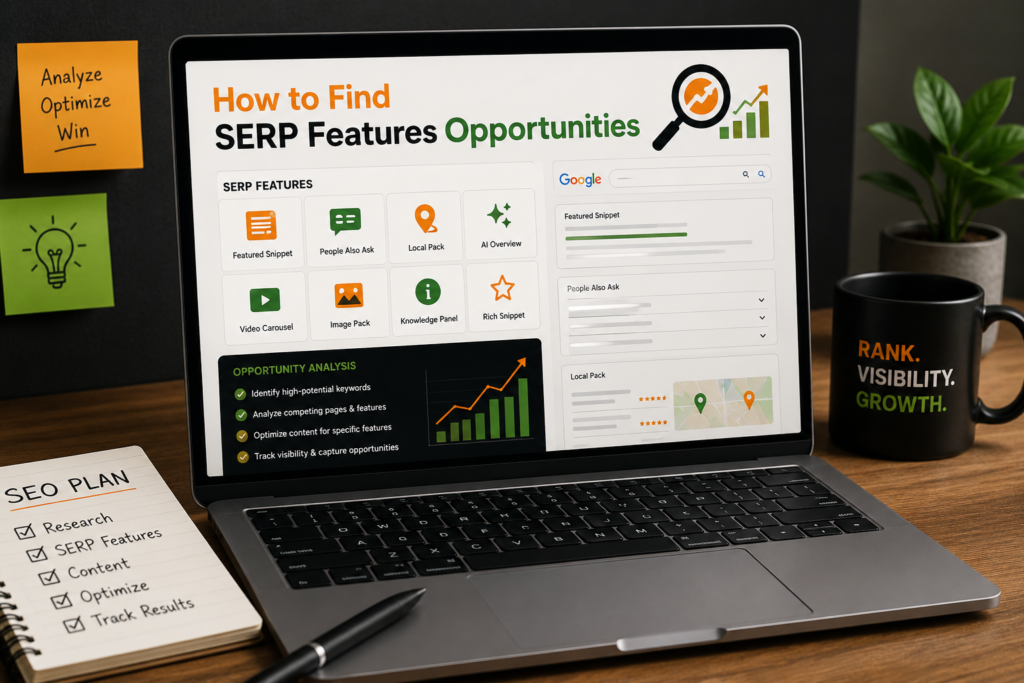
Understanding how to find SERP features opportunities is critical when 8% of search clicks now go to position zero, stealing traffic from traditional organic results. In fact, featured snippets and other SERP features can capture 8.6% of clicks away from the top ranked organic listing below them. These elements go beyond blue links, helping searchers find answers faster without clicking through to websites. Given that SERP features significantly impact your organic visibility, we’ll walk you through proven strategies to identify and capture these high-value opportunities for your content.
What Are SERP Features and Why Do They Matter?
SERP features are elements on search engine results pages that extend beyond traditional organic listings. A Search Engine Results Page displays the complete set of results search engines show for a query, including ads, blue links, and features like People Also Ask, images, nearby businesses for location based queries, and AI Overviews. More than 1,200 different and unique features exist in SERPs. These additional elements affect ranking positions and how users interact with search results.
Finding how to find serp features opportunities becomes essential when you realize that only 1.16% of Google’s first page results appear without SERP features of any kind. SERP features now occupy 60-80% of above-the-fold real estate on most commercial queries. The top organic result often appears below multiple SERP features and commercial placements, sometimes below the first or even second fold. Modern SEO success depends on optimizing for SERP features, not just traditional organic rankings, because visibility is driven by SERP real estate and intent alignment.
The most common SERP features include featured snippets, People Also Ask boxes appearing in 53% of all US based search queries, local packs for location-based searches, knowledge panels, rich snippets enhanced with structured data, and AI Overviews now triggered in more than 30% of searches. Videos show up within search results 52% of the time, while video carousels appear in 28% of searches. Popular Products appear in 59% of shopping queries. Search engines prioritize direct answers that are condensed, summarized, and cited through these features.
How SERP Features Impact Organic Click Through Rates
SERP features correlate negatively with click through rates across most result types. Research analyzing 300,000 keywords found that AI Overviews correlate with a 58% reduction in click through rate for top-ranking pages. Position 2 saw a 50.8% drop, position 3 a 46.4% drop, and the impact decreased further down the SERP. When users encounter an AI summary, they click on a traditional search result in 8% of visits, compared to 15% of visits when no summary is present. Only 1% of users click a link inside the AI summary itself.
Rank positions do not reveal where a site appears on the SERP exactly and how much visibility it actually has. A listing enriched with Schema takes more space and increases the domain’s visibility and click through rate compared to basic title and description formats. Coupled with this, understanding How to Show up in AI Overviews SEO becomes critical as AI driven SERP features increasingly satisfy intent directly, reducing clicks even when rankings remain stable. The greater real estate a brand occupies on the SERP, whether as an organic listing or by showing up in SERP features, the greater search visibility it commands and the more clicks it attracts.
Why Zero-Click Searches Are Changing SEO Strategy
Zero-Click Searches occur when users find their answer directly on the search results page without clicking through to any website. Around 58.5% of U.S. searches and 59.7% of E.U. searches ended without a click in 2024. Research tracking actual browsing behavior from 900 U.S. adults found that roughly 26% ended their browsing session entirely after an AI summary appeared, compared to 16% without one. Bain’s survey finds that about 80% of consumers now rely on zero-click results in at least 40% of their searches, reducing organic web traffic by an estimated 15% to 25%.
This shift fundamentally changes how we measure success. Traditional metrics like click-through rates no longer tell the whole story. You might rank in position one but see minimal traffic because SERP features answer the query directly. As organic click-through rates fall, marketers lose share of voice in high value, non branded searches where people seek answers before committing to a specific brand. Modern SEO requires optimizing for presence, clarity, and visibility across SERP features rather than focusing solely on ranking positions. Measuring performance requires visibility-based metrics that reflect how users actually experience the SERP.
The Main Types of SERP Features You Should Know
SERP features come in many formats, each designed to help users find information faster and more efficiently. Some provide direct answers, others highlight local businesses, while newer AI powered features generate comprehensive responses from multiple sources. Understanding how these search enhancements work is the first step toward identifying valuable visibility opportunities and optimizing your content to appear in them.
Featured Snippets and How They Work
Featured snippets appear as short text excerpts at the top of search results, pulling content directly from a webpage to provide quick answers. Google displays these snippets when its ranking systems determine users seek specific answers that can be addressed by showing passages from relevant webpages. They fall into four primary formats. Paragraph snippets provide concise text answers, often one or two sentences with relevant images in some cases. List snippets present information as numbered steps for sequential processes or bulleted points for unordered items. Table snippets display structured data in rows and columns for easy comparison. Video snippets feature clips with highlighted timestamps addressing the query directly.
Google selects featured snippets based on how well content answers questions and overall helpfulness. Only one snippet typically appears, though multiple can show for certain queries. These boxes appear at the top of results, within People Also Ask sections, or next to Knowledge Graph information on the page’s right side. Featured snippets now appear in only 0.24% of searches according to March 2026 data, a dramatic decrease from previous years.
People Also Ask (PAA) Boxes
People Also Ask displays questions related to the initial search query, helping users explore topics without performing additional searches. Each box initially contains one to four questions. Clicking any question expands it to reveal a short answer pulled from a specific webpage, plus a link to that source. The format varies between paragraphs, bulleted lists, numbered lists, tables, images, or videos. New questions automatically generate with each click, creating an ever expanding feature that can theoretically continue indefinitely, though questions eventually repeat after approximately 204 expansions in extreme cases.
Google tends to return identical PAA questions for queries within the same search topic. Specifically, 99 repeat questions appeared across 195 total PAA questions in one study, with the most frequent appearing 21 times across different searches. Question and answer pairs stick together consistently. When a particular PAA question appears, it almost always cites the same source URL, giving that page exposure across multiple SERPs.
Local Pack Results for Location Based Searches
The Local Pack appears for searches with location intent, displaying three business listings alongside a map showing their locations. This feature includes business names, addresses, phone numbers, star ratings, review counts, operating hours, and website links. Local Pack results appear in 93% of Google searches with local intent. Mobile users see click-to-call options and direction buttons directly within results.
Google determines Local Pack rankings through three factors. Relevance measures how well a business profile matches the search query. Distance calculates physical proximity between the business and the searcher’s location. Prominence reflects how well known a business is, considering review quantity, positive ratings, website backlinks, and overall recognition. Businesses with complete, accurate Google Business Profiles showing current hours and detailed information rank higher in these results.
Knowledge Panels and Knowledge Cards
Knowledge panels are information boxes appearing on the right side of desktop results or near the top on mobile when users search for entities like people, places, organizations, or things within Google’s Knowledge Graph. This massive database contains over 500 billion facts about five billion entities. Panels typically include titles, descriptions, images, key facts such as birth dates or locations, and links to social profiles and official websites.
Information comes from hundreds of web sources, including Wikipedia, licensed databases, and verified entities who claim and update their own panels. Knowledge cards cover similar ground but appear at the top of results rather than the side. Both features are automatically generated and updated as information changes across the web.
Rich Snippets and Structured Data Results
Rich snippets add extra details like ratings, images, prices, cooking times, or availability directly within standard search results. Google pulls this enhanced information from schema markup found in webpage HTML. Common types include review snippets showing star ratings, recipe snippets displaying ingredients and preparation time, product snippets with pricing and availability, event snippets highlighting dates and locations, and organization snippets showing logos and contact details.
Rich snippets don’t directly improve rankings but increase click through rates by making results more visually appealing and informative. Pages need properly implemented structured data to become eligible for rich results. Invalid markup prevents snippets from appearing.
AI Overviews and Generative Search Features
AI Overviews differ fundamentally from featured snippets by generating multi source summaries using AI models like Google Gemini rather than extracting direct passages from single webpages. Understanding How to Show up in AI Overviews SEO requires recognizing that these responses synthesize information across multiple sources, then display citations to supporting websites. The feature appears for 59% of searches with informational intent and 19% of searches with commercial intent.
AI Overviews can include key points lists, expanded detailed answers users reveal by clicking, and linked website sources typically drawn from the top 35 organic positions. Google uses query fan out techniques, issuing multiple related searches across subtopics to develop comprehensive responses, potentially displaying a wider diversity of links than traditional search results.
How to Identify Keywords That Trigger SERP Features
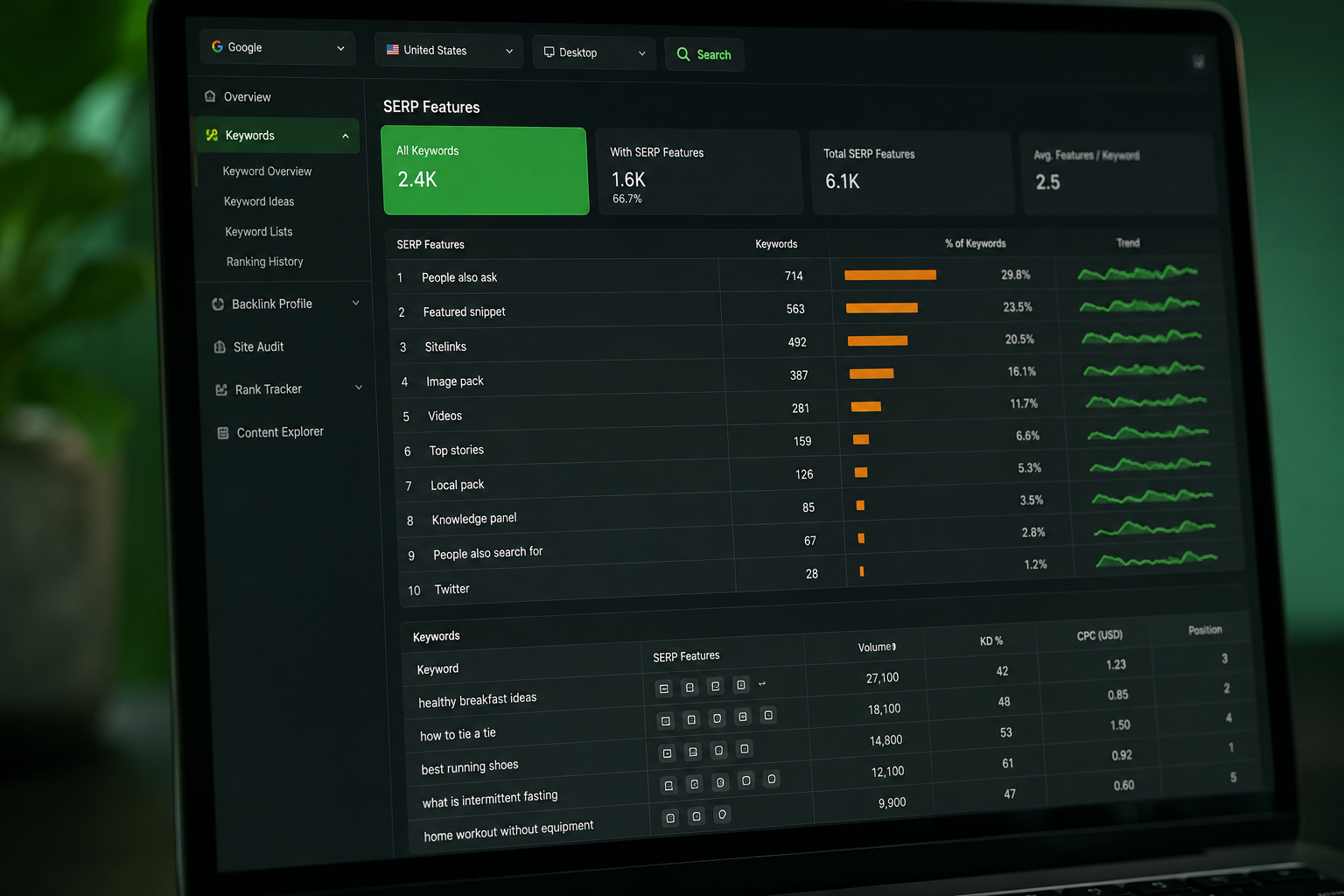
Finding SERP feature opportunities starts with understanding which keywords already trigger enhanced search results. Rather than targeting keywords based solely on search volume, analyze the search results themselves to see where Google displays featured snippets, Local Packs, People Also Ask boxes, AI Overviews, and other SERP features. The following methods can help you uncover high value keywords that offer opportunities to gain additional visibility beyond traditional organic rankings.
Using SEO Tools to Track SERP Feature Visibility
Track every result type appearing on the page for your keyword set rather than focusing solely on organic position. Monitor how often each feature appears, whether it sits above or below the fold, and how much you own versus competitors. A rank tracker reports position but a dedicated SERP feature tracking tool captures the whole layout across every keyword and market.
Record every feature on the page, its order, and whether your result lands above or below the fold. Two listings at position 4 can have completely different real visibility. One is the first thing a user sees while the other is buried under an AI Overview, four ads, and a carousel. The metric that predicts click through rate is above-the-fold presence, not position. Measure your share of SERP at two levels: overall and by individual feature to understand who owns Organic, who owns the AI Overview, and who owns Merchant Listings. AI Overviews appear on roughly 47% of US searches, making them essential to track as SERP features.
Analyzing Competitors Who Own SERP Features
Launch organic rankings tools like SEMrush’s Organic Rankings, enter a competitor’s domain, and navigate to the Positions report. Click the SERP Features tab to see how many features the competitor ranks for. Apply advanced filters to exclude branded keywords and browse through the list to identify relevant terms you can target. Dive into how much traffic the site gets from keywords where they have SERP features. A competitor can be invisible in overall share of voice yet still own the one feature that converts.
Finding Keywords with Featured Snippet Opportunities
Use keyword research tools to find terms that trigger featured snippets. In SEMrush’s Keyword Magic Tool, enter a broad term related to your niche, then click Advanced filters and select the checkbox next to Featured snippet under SERP Features. Focus on question searches, particularly ‘why’ questions which make up 70% of featured snippets. Narrow your focus to keywords where you currently rank in positions two through five on page one, then prioritize those with highest search volume.
Discovering Local Pack Opportunities for Local SEO
Local Pack results appear in 93% of Google searches with local intent. Create and optimize your Google Business Profile with complete, accurate information. Target local keywords specific to the area you operate in, typically a combination of your industry term and a location. Get name, address, and phone number citations on business directories and social media profiles. Google uses these citations to verify your basic business information when determining Local Pack rankings based on proximity, prominence, and relevance.
Structuring Content to Increase SERP Feature Eligibility
Follow standard SEO practices rather than special optimization tactics. Ensure pages remain crawlable and indexable, create helpful content demonstrating expertise and authority, and keep information current. Google’s official guidance states that SEO best practices remain foundational to success with generative AI features. Provide unique viewpoints based on your experience instead of recycling common knowledge. Write for human audiences with clear structure using paragraphs, sections, and headings.
Creating Content That Ranks for People Also Ask
Include PAA questions as H2 or H3 subheadings to signal relevance to Google. Answer questions directly beneath these headings in clear, concise language. Analyze the format of current PAA answers for your target queries. If existing answers appear as paragraphs, replicate that style. If they use bulleted lists, structure your content similarly. Questions beginning with ‘what,’ ‘how,’ and ‘is’ occur most frequently in PAA boxes.
Formatting Your Content for Featured Snippets
Use semantic HTML structure with proper tags. Place H2 or H3 header tags for snippet questions, paragraph tags for answers, ordered list tags for numbered steps, unordered list tags for bulleted points, and table tags for tabular data. Answer the query immediately in the first two sentences following the heading. Align your content format with the snippet type currently ranking. Paragraph snippets average less than 300 characters.
Adding Schema Markup for Rich Snippets
Schema markup is code added to your website’s HTML helping search engines understand content better. Add relevant schema types like Product, Review, Recipe, FAQ, or Organization markup to become eligible for rich snippets. Use JSON LD format, which Google prefers. Generate markup using Google’s Structured Data Markup Helper, then validate with Rich Results Test. Schema doesn’t guarantee rich results but increases eligibility significantly.
Writing Direct Answers to Search Queries
Structure content to deliver primary answers upfront in the first few paragraphs. Use question led subheadings followed by clean answer blocks of 40 to 60 words. Write in literal language without promotional tone. For definitional queries, open with a single defining sentence under sixty words total. For procedural queries, use numbered lists with action oriented steps beginning with verbs. Understanding How to Show up in AI Overviews SEO requires creating extractable, quotable content that AI systems can synthesize with information from other sources.
Common Mistakes That Prevent SERP Feature Rankings
Securing a SERP feature requires avoiding critical errors that disqualify otherwise strong content. No guaranteed method exists for capturing these positions, but eliminating common missteps increases your eligibility substantially.
Ignoring Search Intent When Creating Content
Matching user intent remains the foundation for SERP feature eligibility. Cramming target keywords into every paragraph fails when content doesn’t actually satisfy what searchers need. Write naturally for humans first, then optimize for search engines. Trying to convert someone at the awareness stage with aggressive sales content backfires.
Creating generic content that could apply to any company fails to demonstrate the experience and expertise that satisfy user intent. Identify whether queries carry informational, navigational, transactional, or commercial investigation intent before creating content. Product pages won’t rank for informational queries no matter how well optimized.
Failing to Use Structured Data Properly
Structured data errors prevent Google from parsing markup correctly, making pages ineligible for rich results. Missing required properties invalidates entire schema implementations. Choosing incorrect schema types confuses search engines. Syntax errors like missing commas, curly brackets, or square brackets break JSON LD markup entirely. HTML tags incorrectly pulled into structured data make markup unparsable. Validate implementations using Rich Results Test during development and monitor Rich Result status reports after deployment.
Not Optimizing for Mobile SERP Features
Over 60% of searches happen on mobile devices. Content that loads slowly or displays poorly on mobile fails to match user intent regardless of quality. Implement responsive design ensuring pages adapt seamlessly to smaller screens. Use shorter paragraphs, bullet points, and clear headings for easy mobile reading.
Overlooking Competitor SERP Feature Strategies
Competitors invisible in overall rankings can still own the specific features that convert. Analyze which domains capture featured snippets, PAA boxes, and local packs for your target keywords. Study their content structure, answer formats, and schema implementations to identify replicable patterns.
How to Find SERP Features Opportunities: FAQs
What is the easiest way to find SERP feature opportunities?
The easiest method is to search your target keywords in Google and analyze which SERP features already appear. You can also use SEO tools like SEMrush, Ahrefs, or SE Ranking to filter keywords by featured snippets, People Also Ask boxes, Local Packs, AI Overviews, and other SERP features.
Which SERP features are most valuable for increasing visibility?
Featured snippets, AI Overviews, People Also Ask boxes, Local Packs, and rich snippets typically provide the greatest visibility because they occupy prominent positions above traditional organic results and attract significant user attention.
Can a website rank in both organic results and a SERP feature?
Yes. A webpage can appear in a featured snippet, People Also Ask box, or AI Overview citation while also ranking in the organic search results. This increases overall search visibility and can improve brand exposure.
How do I know if a keyword triggers a SERP feature?
Simply search the keyword in Google and review the results page. Alternatively, keyword research tools can show which SERP features appear for specific keywords, helping you identify opportunities at scale.
Are SERP features more important than traditional rankings?
Both matter, but SERP features often capture the most visible areas of the search results page. In many cases, appearing in a SERP feature can generate more visibility than ranking in a standard organic position.
How can I improve my chances of earning a featured snippet?
Provide a direct answer immediately below a relevant heading, use clear formatting, and structure information with concise paragraphs, lists, or tables. Content that clearly answers a searcher’s question is more likely to be selected.
Does schema markup help with SERP features?
Yes. Schema markup helps search engines better understand your content and can increase eligibility for rich results such as review snippets, FAQs, product information, events, and other enhanced search features.
How often do SERP features change?
SERP features can change frequently based on search intent, algorithm updates, competition, and user behavior. Regular monitoring is essential to identify new opportunities and maintain visibility.
Can small websites compete for SERP features?
Absolutely. Google primarily rewards content that best answers the query rather than the largest website. Well structured, authoritative content from smaller sites can earn featured snippets, PAA placements, and AI Overview citations.
Wrapping Up
You now have everything needed to capture SERP features and increase your search visibility beyond traditional rankings. The reality is clear: position one means little when AI Overviews, featured snippets, and local packs dominate the page. Start by tracking which features appear for your target keywords, then structure your content accordingly. Answer questions directly, implement schema markup correctly, and match search intent precisely.
Most importantly, focus on claiming space across multiple SERP features rather than obsessing over rank position alone. SERP feature optimization takes time and testing. Monitor your visibility metrics, analyze what competitors own, and keep adapting. Your traffic depends on it.