
Do rich snippets help SEO? The data reveals something remarkable: rich snippets can boost click-through rates by 15% to 30%, with some generating an average of 58 clicks per 100 queries. Studies even show they can drive 20-30% more organic traffic and generate 677% more revenue. Given that standing out in search results has become increasingly competitive, understanding how rich snippets improve SEO is no longer optional.
In this guide, I’ll walk you through what rich snippets in SEO actually are, how do rich snippets benefit SEO with real data, and how to implement them correctly on your website. We’ll cover the different types available, common implementation mistakes, and whether they’re worth your time investment.
What Are Rich Snippets in SEO
Rich snippets in SEO are enhanced search results that display additional information beyond the standard title, URL, and meta description. A rich snippet is a standard organic search listing that Google has expanded with extra information extracted from structured data embedded in the page’s HTML. Instead of showing only the title, URL, and meta description, a rich snippet can display review stars, price, stock availability, cooking time, event dates, FAQ questions, or breadcrumb paths details that help a searcher decide whether to click before they ever visit the site.
Technically, Google stopped using the term “rich snippets” in 2017 and now calls the entire category rich results, but the industry still uses the older phrase interchangeably. The important distinction is between rich results (powered by schema markup you control) and featured snippets (answer boxes Google extracts algorithmically from a page, often without any structured data at all). Confusing the two leads to wasted optimisation effort; we will break that difference down later.
For a layman, think of schema markup as a translator. Your web page speaks human; structured data speaks search‑engine. When you wrap your product name, price, and rating inside Product schema written in JSON‑LD, you are handing Google a neatly labelled box rather than asking it to guess what each number on the page means.
How Rich Snippets Work
Structured data serves as the foundation for rich snippets. When you add Schema.org markup to your pages, you’re providing explicit information that helps search engines understand your content. Google supports several formats, including JSON-LD, Microdata, and RDFa, though JSON-LD is the preferred method. The search engine reads this code and uses it to create rich results in the SERPs. As leading SEO Agency in Milton Keynes, we’ve implemented structured data for hundreds of clients, and the process involves adding standardized code that classifies your page content in a format search engines can interpret.
Are Rich Snippets a Google Ranking Factor?
This is the question that generates the most debate, so let’s settle it with the official line: no, structured data is not a direct Google ranking factor. Google’s John Mueller and the Search Central documentation have said this consistently for years, and the June 2025 deprecation of several schema types was accompanied by an explicit statement that the removals “won’t affect how pages are ranked”.
However, this doesn’t mean rich snippets lack SEO value. The distinction matters because rich snippets influence user behavior, and user behavior signals affect rankings over time. A page that displays star ratings, price, and availability occupies more visual space in the SERP, sometimes double the pixel height of a standard result. Multiple studies have found that rich results capture roughly 58% of clicks versus 41% for plain listings on the same page.
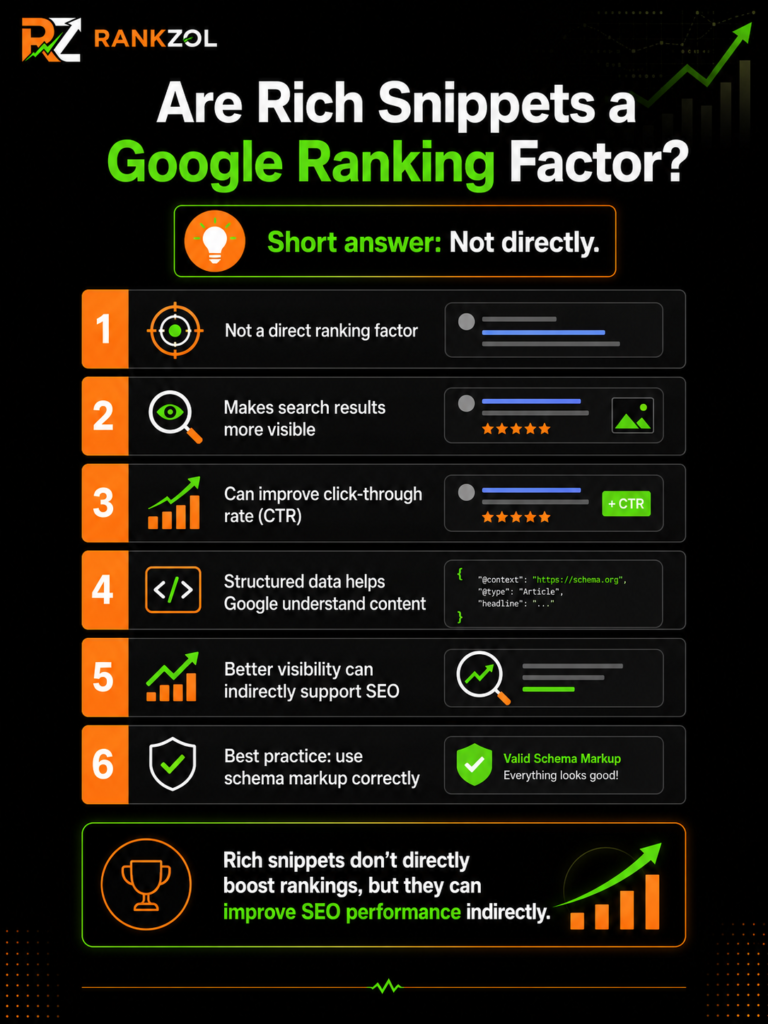
A higher click‑through rate is not a ranking factor in the classical sense, but Google’s systems particularly RankBrain and the 2025‑era AI‑driven ranking components use user‑interaction signals to calibrate relevance. If your page consistently draws clicks that a competitor’s does not, the algorithm notices.
Types of Rich Snippets
Google supports numerous rich snippet types, each designed for specific content categories. The most common types include products, reviews, recipes, FAQs, and events. Selecting the right markup for your content type determines eligibility for enhanced displays.
Product Snippets
Product markup displays essential information like price, availability, and star ratings directly in search results. These snippets work for e-commerce sites and pages featuring products for sale. Google distinguishes between product snippets (for pages where users can’t directly purchase) and merchant listings (for direct purchase pages).
Review Snippets
Review snippets showcase star ratings out of 5, either from individual reviewers or aggregate user reviews. These apply to products, recipes, movies, local businesses, and software apps. The visual star ratings immediately establish credibility before users click through.
Recipe Snippets
Recipe structured data includes preparation time, cooking duration, nutritional information, and dish images. Food blogs benefit significantly from this markup, as recipe snippets provide at-a-glance information that helps users decide which recipe to follow.
FAQ Snippets
FAQ rich results display questions and answers in expandable sections within search results. However, Google restricts this feature to well-known, authoritative government and health-focused websites. The markup requires at least one valid question-answer pair.
Event Snippets
Event markup shows dates, times, locations, and ticket information for upcoming events. This structured data only works for future events and helps users discover concerts, festivals, and organized gatherings through Google Search and Maps. Understanding what are rich snippets and how they function sets the stage for implementation strategies that do rich snippets help SEO performance.
| Rich Result Type | Best For | Key Properties |
|---|---|---|
| Review Snippet | Products, services, local businesses, books, movies | reviewRating, author, datePublished |
| Product | E‑commerce product pages | name, image, price, priceCurrency, availability |
| Product Variants (new Feb 2024) | Sites with size/colour variants | ProductGroup, hasVariant, variesBy |
| Recipe | Food blogs, culinary sites | name, image, recipeIngredient, cookTime |
| Event | Conferences, webinars, local meetups | name, startDate, location, offers |
| LocalBusiness | Brick‑and‑mortar shops, service‑area businesses | name, address, telephone, openingHours |
| Breadcrumb | All sites (desktop only) | BreadcrumbList, itemListElement |
| Article | News, blog posts, thought leadership | headline, author, datePublished, image |
| Video | Pages with embedded video content | name, description, thumbnailUrl, uploadDate |
| Discussion Forum (new Nov 2023) | Community sites, Q&A platforms | DiscussionForumPosting |
| Loyalty Programme (new June 2025) | Retailers with membership tiers | MemberProgram, MemberProgramTier |
The practical takeaway: review your current schema inventory. Many sites we audit at RankZol still have FAQ markup on every page, which Google now ignores unless you are the NHS or a government department. Removing deprecated schema reduces page bloat and eliminates validation noise.
Benefits of Rich Snippets
Beyond the CTR lift already described, rich snippets deliver four concrete benefits that compound over time.
1. SERP Real Estate Dominance. A product listing with review stars, price, and stock status can take up 30–50% more vertical space than a plain text result. On mobile, where screen real estate is scarce, that visual footprint often means your result is the only one fully visible above the fold.
2. Pre‑Qualified Traffic. When a searcher sees a 4.7‑star rating, a £49 price point, and “In Stock” before clicking, they have already self‑selected. The traffic that lands on your page has higher commercial intent and lower bounce rates. We have measured bounce‑rate reductions of 12–18% on product pages after implementing review and product schema, visitors arrive knowing what to expect.
3. Enhanced Entity Association. Structured data helps Google populate its Knowledge Graph. Consistent use of Organization and LocalBusiness schema across your site strengthens Google’s understanding of your brand entity. This matters for Wikipedia‑level entity recognition and can influence whether your business appears in knowledge panels for branded queries.
4. AI‑Readiness. This is the benefit most SEOs still overlook. Google’s AI Overviews which appeared on roughly 13% of searches by mid‑2025 pull from pages that use structured data to organise information clearly. A well‑marked‑up product comparison table or FAQ section is now more likely to be cited inside an AI‑generated answer. Structured data in 2026 serves dual purpose: it earns the visual enhancement in classic search and feeds the machine‑readable content layer that powers generative search experiences.
These benefits are not theoretical. After implementing review, product, and breadcrumb schema, RankZol tracked a 29% month‑on‑month increase in organic revenue driven entirely by higher CTR and better‑qualified traffic, not ranking shifts. The client’s average position for their top 50 keywords remained flat. The difference was that more of the people who saw the listing clicked, and more of those who clicked bought.
How to Create Rich Snippets
Creating rich snippets is a three‑stage process: choose the right schema type, implement it correctly, and validate it. Here is the workflow RankZol uses.
Map Content to Schema Types
Every page template should carry only the schema that matches its purpose. A blog post gets Article. A product page gets Product (or ProductGroup for variants). A contact page gets LocalBusiness or Organization. Never blanket‑apply the same schema site‑wide that is how you trigger “spammy structured data” manual actions in Search Console.
Implement JSON‑LD
Google explicitly recommends JSON‑LD (JavaScript Object Notation for Linked Data) over Microdata and RDFa. JSON‑LD sits inside a <script type="application/ld+json"> tag, typically in the page <head>, and does not interfere with your visible HTML.
Common Mistakes You Should Avoid
1. Marking Up Invisible Content. Google’s policy is unambiguous: structured data must describe content that is visible to the user on the page. Marking up reviews, prices, or event details that exist only in the schema not in the rendered HTML risks a manual action.
2. Using Deprecated Schema Types. We still encounter sites relying on HowTo and FAQPage markup expecting rich results. These types no longer trigger enhanced listings. Remove them or repurpose the structured content into formats Google actually rewards, such as well‑formatted HTML tables that can be cited in AI Overviews.
3. Incomplete Required Properties. Each schema type has mandatory fields. A Product without price or availability will not qualify. An Event without startDate will fail validation. Google’s documentation lists required versus recommended properties treat the required ones as non‑negotiable.
4. AggregateRating on Pages with No Reviews. Fabricating review data to earn star snippets is spam. Google’s algorithms detect mismatches between schema values and on‑page content, and penalties for spammy structured data can remove your entire site from rich‑result eligibility.
5. Schema on Irrelevant Pages. Applying Product markup to a category listing page is incorrect schema should live on leaf pages, not index pages. Category pages that aggregate multiple products are not eligible for product rich results and can confuse Google’s parser.
6. Ignoring Search Console Reports. Google Search Console provides a dedicated Rich Results section that flags errors, warnings, and fully valid pages. Checking this dashboard monthly catches issues before they become entrenched.
At RankZol, roughly one in three new client sites we audit has at least one of these mistakes present. The most common is FAQ markup on every page a legacy tactic that stopped working in 2023 but persists because no one reviewed the schema inventory after Google’s policy change.
How to Test Rich Snippets Using Google Testing Tool
Google provides two primary tools, and the distinction between them is essential:
1. Rich Results Test
This is the tool that tells you whether your page is eligible for Google rich results. Enter a URL or paste a code snippet; it returns a list of detected rich‑result types and flags any errors or warnings against Google’s specific requirements. Use this tool before launch and whenever you update templates or plugins.
2. Schema Markup Validator
This validates your markup against the full schema.org specification, not just Google’s subset. It catches syntax errors, missing brackets, and type mismatches that the Rich Results Test might not surface because Google does not use those specific schema types.
Recommended testing workflow: Run the Schema Markup Validator first to catch syntax issues. Fix any errors. Then run the Rich Results Test to confirm Google eligibility. Finally, use the URL Inspection Tool inside Google Search Console to see the rendered HTML and structured data exactly as Googlebot sees it.
After deployment, monitor the Enhancements and Rich Results reports in Search Console for ongoing validation. A sudden spike in errors often correlates with a plugin update or theme change that broke the JSON‑LD output.
When Should You Optimize for Rich Snippets?
Rich‑snippet optimisation is not a one‑time project; it is a continuous cycle tied to your content strategy. However, certain moments deliver disproportionate returns:
-
Site Launch or Redesign: Build schema into your page templates from day one. Retrofitting structured data across hundreds of pages is expensive and error‑prone.
-
E‑commerce Product Launches: New product pages should ship with complete
ProductandOffermarkup pre‑validated. The first 48 hours of indexing are when Google forms its understanding of the page. -
After a Google Algorithm Update: Major updates often change which rich‑result types appear for which queries. Review your schema strategy within two weeks of a confirmed broad core update.
-
When Competitors Start Earning Rich Results You Lack: Run a SERP analysis for your top 20 keywords. If competitors consistently display review stars, product pricing, or event details and you do not, that is a clear gap to close.
-
Before Peak Season: Retailers should validate all product and review markup in October for the Christmas trading period. Event organisers should do the same six weeks before their conference season.
-
When Google Announces Schema Changes: The June 2025 deprecation wave is the model example. Sites that acted within 30 days removed dead markup and reallocated effort to supported types; sites that did nothing still carry deprecated code that clutters their pages and Search Console reports.
How to Choose the Right Rich Snippets for Your Content
Matching schema type to page intent prevents wasted effort. Here is the decision framework we use at RankZol:
| Page Intent | Recommended Schema | Why |
|---|---|---|
| Sell a physical product | Product + Offer + AggregateRating (if genuine reviews exist) |
Displays price, availability, and stars directly in the SERP |
| Promote a local service | LocalBusiness + Review |
Triggers local pack features and review snippets |
| Publish editorial content | Article + BreadcrumbList |
Enables article carousel eligibility and breadcrumb trails |
| Host an event | Event + Offer |
Shows dates, location, and ticket availability |
| Publish a recipe | Recipe |
Displays image, cook time, rating, and calorie count |
| Run a membership programme | MemberProgram + MemberProgramTier |
New in 2025; shows loyalty benefits for qualifying retailers |
| Operate a community forum | DiscussionForumPosting |
New in 2023; surfaces forum threads in search |
The golden rule: one schema type per page intent. A product page should not also carry Article markup, and a blog post should not try to trigger Product rich results. Google’s parser expects coherence between the page’s visible content and its structured data; conflicting signals reduce the likelihood of either type appearing.
How Rich Snippets Increase Organic Click-Through Rate (CTR)
The mechanism is psychological, but the data is hard. An All in One SEO study found that rich results earn roughly 58% of clicks on SERPs where they appear, compared with 41% for standard blue links. Other analyses have pegged the CTR lift for review‑snippet pages at 20–30%. Why? Three factors plays dominant role, let’s note down!
Visual Contrast. A listing with gold stars and a visible price point breaks the monotony of a text‑only SERP. The human eye is drawn to colour and shape variation; rich snippets exploit that reflex.
Information Advantage. A searcher looking for a product can see the price, rating, and stock status before clicking. They are making an informed choice, not taking a gamble. This reduces pogo‑sticking: the behaviour where a user clicks a result, hits back, and clicks a different one which Google interprets as a negative relevance signal.
Trust Proxy. Review stars communicate social proof instantly. Even a 4.2‑star rating displayed next to your listing signals that real users have validated your product or service. In competitive SERPs where three or four results carry review snippets, the listing without stars looks conspicuously less trustworthy.
At RankZol we quantify this for every client. Using Search Console’s Search Appearance filters, we isolate impressions and clicks for pages with rich results versus those without. The CTR differential is consistently 15–40% in favour of enriched listings for the same position bracket.
Difference Between Rich Snippets and Featured Snippets
This confusion costs SEOs time. The two terms describe fundamentally different SERP features:
| Feature | Rich Snippets (Rich Results) | Featured Snippets |
|---|---|---|
| What it is | Enhanced organic listing with extra data (stars, price, date) | Answer box extracted from a page, displayed above organic results |
| How triggered | Structured data (schema markup) added to the page | Google algorithmically extracts content; no markup required |
| SERP position | Appears within normal organic results (positions 1–10) | Appears at “position zero,” above all organic results |
| Control | You control what markup you provide; Google decides display | Google decides entirely you influence through content structure |
| Example | Product listing with star rating and price | Paragraph, list, or table answering “what is” or “how to” queries |
| Visibility trend | Stable, with new types added in 2024‑2025 | Dropped 64% in visibility between January–June 2025 due to AI Overviews expansion |
A page can earn both a rich snippet and a featured snippet simultaneously for example, a recipe page that displays star rating and cooking time (rich result) while also appearing as the featured snippet paragraph for “how to make sourdough bread.” But the mechanisms are independent: structured data earns the former; exceptional content clarity earns the latter.
The 2025–2026 twist is that featured snippets and rich results are increasingly subsumed into AI Overviews. When Google generates an AI‑powered summary at the top of the SERP, it often suppresses both the featured snippet and some rich‑result displays. This does not make structured data irrelevant, it makes it more important, because AI Overviews cite pages with well‑organised, schema‑marked content more frequently than pages without.
Work With RankZOL to Maximize Your Rich Snippet Strategy
So do rich snippets help SEO? Absolutely, and the evidence is both consistent and significant. Not as a direct ranking shortcut, but as a proven technical strategy that increases SERP visibility, drives higher click-through rates, builds user trust before the first click, and positions your website to benefit from every evolving Google search feature including AI Overviews and voice search.
At RankZOL, we have implemented structured data as part of comprehensive SEO campaigns across dozens of businesses spanning local service firms, e-commerce stores, professional practices, SaaS platforms, and national brands across the UK and USA. The results are consistent: pages with properly implemented, regularly audited schema markup consistently outperform those without it across CTR, engagement, and conversions. If you want a team that understands not just how rich snippets work, but how to deploy them as part of a broader, data-driven, performance-focused SEO strategy and get your free website SEO audit from RankZOL today and find out exactly where your website stands.