
Search is not what it used to be. A few years ago, getting your business to the top of Google meant following a set of well-known rules: write good content, build links, and make your website fast. But in 2026, the rules have quietly shifted underneath everyone’s feet. Businesses that rely solely on traditional search engine optimization are already beginning to lose ground, especially in competitive niches. If you are running a property business, for example, investing in SEO for letting agents is still important but it no longer tells the whole story. Today, you also need to understand two newer disciplines that are changing how people find information online: Answer Engine Optimization and Generative Engine Optimization.
Most business owners have heard of SEO. But the arrival of AI-powered search tools like Google’s AI Overviews, ChatGPT Search, and Perplexity has created two new battlegrounds that many have not caught up with yet. These tools do not just rank web pages they read them, summarize them, and sometimes skip your website entirely to answer a user’s question directly. For letting agents and property professionals, this is a significant shift. SEO for letting agents now needs to sit alongside a broader content strategy that considers how AI engines digest and present your information. If your content is not structured in the right way, you could be invisible even when you rank on page one.
What Is SEO And Why It Still Matters?
Search Engine Optimization, or SEO, is the practice of making your website visible on traditional search engines like Google and Bing. It involves on-page content, technical health, backlinks, and local signals. For a letting agent in Manchester or Birmingham, good local SEO for letting agents means showing up when someone searches “letting agents near me” or 2-bedroom flat in Didsbury to rent.” It is still incredibly valuable and should never be abandoned.
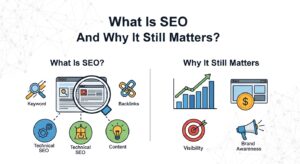
The key thing to understand is that SEO targets search engine algorithms. These algorithms crawl your pages, score your content, and decide where you appear on a results page. A well-optimised website earns clicks. But here is the problem users are clicking less. With AI summaries now appearing at the very top of Google, many people get their answer without ever reaching your site. That is where AEO comes in.
What Is AEO Answer Engine Optimization
Answer Engine Optimization is about making your content easy for AI systems to extract and present as a direct answer. When someone asks Google “what fees do letting agents charge?” and an AI Overview appears at the top with a clear response, that answer came from a specific piece of content somewhere on the web. AEO is the practice of making sure that content comes from your website.

To optimise for answer engines, your content needs to be written in a question-and-answer format. Think about the real questions your customers type into Google. Write a clear question as a subheading, then answer it in two to four sentences immediately below. Use structured data markup where possible, keep your language plain, and make sure your page loads quickly. This is especially useful for property SEO strategies — questions like “how much notice does a landlord have to give” or “what is a tenancy deposit scheme” are exactly the kind of things people ask AI tools directly.
What Is GEO Generative Engine Optimization
Generative Engine Optimization is newer and slightly different. While AEO focuses on traditional AI search features like snippets and voice answers, GEO is specifically about how large language models ChatGPT, Gemini, Claude, Perplexity generate responses that cite or reference web content. When someone uses ChatGPT Search and asks “which letting agents in Leeds are worth using?” the model draws from indexed, credible content it has encountered during training and real-time browsing.
To rank in these generative results, your content needs to demonstrate credibility and depth. Original data, clear expert opinion, well-sourced facts, and consistent publishing history all help signal to these models that your content is worth referencing. For businesses working on AI search visibility for estate agents, this means moving beyond keyword-stuffed pages and investing in genuinely useful, well-written content that establishes authority in your niche.
How All Three Work Together in 2026
The businesses seeing the best results right now are not choosing between SEO, AEO, and GEO they are doing all three, and they understand how each one supports the others. SEO gets you indexed and trusted by search engines. AEO gets your content surfaced as direct answers. GEO gets your brand mentioned in AI-generated responses. Together, they create multiple layers of visibility across all the different ways people now search for information.
For letting agents and property businesses specifically, the opportunity is significant. Most competitors are still thinking purely in terms of traditional SEO, which means there is real room to get ahead by being an early mover in AEO and GEO content. Write detailed guides that answer tenant and landlord questions directly. Publish honest, experience-led content about your local market. Build a track record of quality that AI models will recognise and reference. A complete approach to SEO for letting agents in 2026 needs to factor in all of this not just rankings, but answers, citations, and AI-driven visibility.
Practical Steps to Get Started
The first step is an honest audit of your current content. Is it written in clear, plain language that answers real questions? Does it go into useful detail, or does it skim the surface? Is it structured with clear headings that a machine could read and summarise? If the answer to any of these is no, that is your starting point.
From there, build a content plan that includes question-led articles, local area guides, FAQ pages structured with proper markup, and regular publishing to show AI models that your site is active and reliable. Track not just your Google rankings, but whether your content appears in AI Overviews, Perplexity results, or ChatGPT responses. These are your new visibility metrics for digital marketing for letting agents in the AI era.
Conclusion
The search landscape in 2026 is genuinely more complex than it has ever been but that also means the opportunity for well-prepared businesses has never been greater. SEO remains the foundation, but it is no longer enough on its own. Answer Engine Optimization and Generative Engine Optimization are not buzzwords to ignore; they are real, measurable channels through which your potential customers are now finding information and choosing who to trust.
For property professionals, the path forward is clear. A modern approach to SEO for letting agents means writing content that both search engines and AI tools can understand, trust, and reference. It means thinking like a publisher, consistent, credible, and genuinely helpful. Whether you are just starting out or looking to rebuild a stale content strategy, the businesses that invest in all three SEO, AEO, and GEO will be the ones that stay visible no matter how search continues to evolve.
Frequently Asked Questions
- What is the difference between SEO, AEO, and GEO?
SEO helps your website rank on Google. AEO gets your content picked as a direct answer by AI tools. GEO helps AI models like ChatGPT reference or mention your business in their responses.
- Is SEO still worth investing in for letting agents in 2026?
Yes, absolutely. SEO for letting agents remains the foundation of any online visibility strategy. Without it, your site won’t be trusted or indexed properly — and AEO and GEO both rely on that base.
- What is an Answer Engine?
An answer engine is a tool that gives users a direct answer instead of a list of links. Google’s AI Overviews, Siri, and Alexa are good examples. AEO helps your content get chosen as that answer.
- How does GEO differ from AEO?
AEO targets AI features within search engines like Google. GEO focuses on getting your content cited or used by standalone AI tools like ChatGPT, Perplexity, and Gemini when they generate responses.
- How can letting agents optimise for AI search?
Write content that directly answers common landlord and tenant questions, use clear headings, publish consistently, and build credibility through original, well-researched material on your website.
- Do I need a separate strategy for AEO and GEO?
Not entirely. A lot of the work overlaps — clear writing, structured content, and genuine expertise help with both. You mostly need to adjust how you think about content goals, not start from scratch.
- Will AI tools replace Google search completely?
Not in the near future. Google is still dominant, but AI tools are growing fast. Smart businesses are preparing for both rather than waiting to see which one wins.
- What kind of content works best for AEO?
Short, direct answers to specific questions work best. FAQ pages, how-to guides, and clearly structured articles with proper headings are exactly what answer engines look for.
- How long does it take to see results from GEO?
GEO is a longer game than traditional SEO. Building the kind of credibility that AI models recognise takes consistent publishing over several months, but the results compound over time.
- Where should a letting agent start if they’re new to all of this?
Start with the basics — make sure your website is technically healthy, your local SEO is in order, and your content answers real questions your clients actually ask. That covers SEO and AEO in one go.