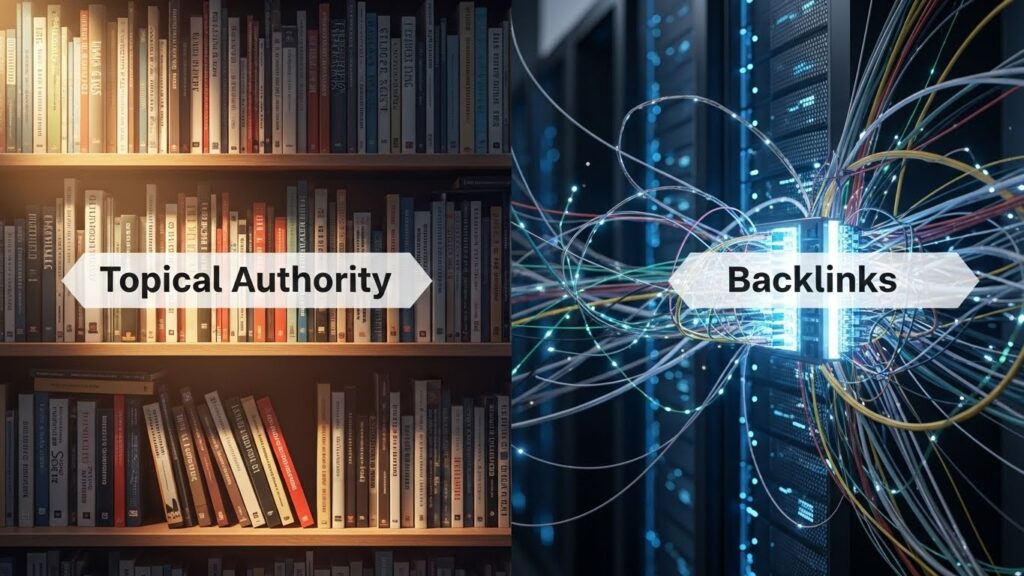
Over 90% of property searches start online, making SEO for letting agents more crucial than ever before. With 99.22% of users never scrolling past page one, the core of the competition to rank high centers on the strategic balance between Topical Authority vs Backlinks, a dynamic that has never been fiercer.
As we move into 2026, letting agent SEO strategies face an important question: should you focus more on building topical authority or acquiring quality backlinks? The answer isn’t straightforward. While backlinks have traditionally been the cornerstone of SEO success, topical authority is gaining significant traction. In fact, real estate SEO showed an estimated 1,389% ROI in 2025, highlighting the massive potential when you get your strategy right.
Throughout this article, we’ll examine both approaches, when each matters most, and how you can balance them to maximize your online visibility. Additionally, we’ll explore why SEO drives 1000%+ more traffic than organic social media and how you can leverage this to grow your letting agency.

What is topical authority and how is it different from backlinks?
Search engine success hinges on understanding two fundamental concepts. As a letting agent, grasping these distinctions can dramatically impact your visibility online.
Definition of topical authority
Topical authority refers to your website’s perceived expertise and trustworthiness in a specific subject area. Essentially, it’s how well you demonstrate comprehensive knowledge about a particular topic, such as the niche focus required for SEO for Letting Agents. Strong topical authority builds confidence in your brand for both readers and search engines alike, leading to more returning site visitors and higher rankings.
For letting agents, this means becoming the go-to resource for everything related to property management, tenant rights, or local housing markets. According to industry research, over 90% of SEO specialists consider topical authority an important part of their content strategy.
Definition of backlinks
Backlinks are hyperlinks from external websites that point to pages on your site. These inbound links function as “votes of confidence” from other websites, signaling that your content is valuable enough to reference. They form the cornerstone of Google’s original algorithm (PageRank) and remain one of their three most important search engine ranking factors.
For letting agents, quality backlinks from property portals, local business directories, or real estate publications can significantly boost your visibility. Moreover, of the 20 factors that most strongly correlate with high rankings, eight are backlink-related.
How search engines use both for ranking
Search engines like Google use sophisticated algorithms to evaluate both topical authority and backlinks when determining rankings. Consequently, pages with comprehensive topic coverage and strong backlink profiles tend to rank higher in search results.
Topical authority is evaluated through content depth, relevance, and how well your content answers user questions. Google’s Experience, Expertise, Authoritativeness, and Trust (E-E-A-T) guidelines specifically emphasize knowledge and credibility.
In comparison, backlinks contribute to your site’s overall domain authority. They help search engines discover new content and distribute ranking value across the web. Furthermore, earning backlinks from reputable sources tells search engines that your content is valuable.
Interestingly, these concepts work together synergistically. Sites with strong topical authority naturally attract more quality backlinks, creating a virtuous cycle that benefits letting agent SEO strategies.

Why topical authority is gaining more weight in 2026
The search landscape has dramatically evolved in 2026. Currently, businesses that demonstrate comprehensive expertise on a subject outperform those relying solely on link-building strategies.
Google’s shift toward content depth and relevance
Search engines now prioritize content that thoroughly addresses topics and provides genuine value to users. This shift aligns with Google’s Experience, Expertise, Authoritativeness, and Trustworthiness (E-E-A-T) guidelines, which emphasize knowledge and credibility. Naturally, websites with in-depth topic coverage are more likely to be highlighted as authoritative sources in search results. Rather than creating pages around individual keywords, letting agent SEO now requires building topic clusters that showcase expertise across related property management subjects.
The role of semantic search and user intent
Search is no longer about exact keyword matching but understanding the meaning behind queries. Semantic search connects user intent with content context to provide relevant results. For letting agents, this means creating content that addresses why someone is searching, not just what they’re typing. User queries fall into four intent categories: informational, navigational, transactional, and commercial. By aligning content with these intents, letting agents can capture high-quality leads at different stages of the property search journey.
Impact of AI-generated answers and AEO
Perhaps the most profound change comes from AI-powered search. Indeed, over 58% of Google searches now result in zero clicks as AI overviews dominate results. Throughout 2026, Answer Engine Optimization (AEO) has become essential as AI systems pull information from authoritative sources to provide direct answers. For letting agents, this means structuring content to be “lifted” by AI algorithms. Ultimately, those who optimize for AI visibility see higher-quality traffic, as visitors arriving via AI referrals show 27% lower bounce rates and 38% longer visits.
When backlinks still matter more than authority
Despite the growing importance of topical authority, backlinks remain crucial in several scenarios for letting agents looking to outperform competitors.
High-competition niches and new websites
In highly competitive property markets, backlink quantity and quality become decisive ranking factors. High-competition niches often require hundreds or even thousands of quality backlinks to rank well. For new letting agent websites, backlinks provide the initial credibility boost needed to gain visibility. They help search engines discover your content faster and accelerate indexing.
A study revealed that websites with between 30 and 35 backlinks generate over 10,500 visits monthly, highlighting their traffic-driving potential. Nevertheless, building backlinks strategically from day one remains more effective than waiting several months after launch.
Trust signals and domain authority
Backlinks serve as powerful trust signals that Google uses to evaluate your site’s credibility. In fact, they remain one of Google’s top three ranking factors. Quality links from authoritative sources enhance your domain’s trustworthiness, which directly impacts rankings.
Trust is considered the most important member of the E-E-A-T family because untrustworthy pages have low E-E-A-T regardless of their expertise or authority. For letting agents, establishing these trust signals through backlinks from property portals and industry publications creates a foundation upon which topical authority can later be built.
Backlinks as a shortcut to visibility
Although topical authority provides long-term benefits, backlinks can deliver faster results in certain scenarios. Particularly for letting agents entering competitive markets, strategic link acquisition creates shortcuts to visibility.
Fixing broken backlinks that previously pointed to competitor sites offers an especially effective tactic. Similarly, leveraging existing partnerships for backlinks places your brand in relevant industry conversations.
Above all, backlinks from diverse sources strengthen your overall profile. The more domains that link to you, the more your popularity increases, creating a network effect that amplifies your letting agent SEO efforts across multiple search scenarios.

How to build topical authority without ignoring backlinks
The winning approach in 2026 combines both strategies into one cohesive plan. Building topical authority alongside strategic backlink acquisition creates the strongest foundation for letting agent websites.
Create content clusters around core topics
Topic clusters demonstrate subject matter expertise to search engines and help potential clients find information without leaving your website. Firstly, develop a comprehensive “pillar page” covering a broad property management topic. Subsequently, create supporting cluster pages that explore specific aspects in depth. For instance, a pillar page about “Property Management in [Your City]” could link to cluster pages about tenant screening, maintenance schedules, and rental regulations.
Use internal linking to strengthen topic depth
Internal links connect your content meaningfully while distributing link value evenly. Link from supporting pages upward to pillar content, then link supporting pages to each other sequentially. Therefore, descriptive anchor text is crucial avoid generic phrases like “click here” in favor of keyword-rich text that describes the destination.
Earn backlinks through high-value content
High-quality, original content naturally attracts backlinks. Content formats that consistently earn citations include:
- Original research and industry data
- In-depth guides and how-to articles
- Tools or calculators that simplify processes
Leverage local SEO for letting agent SEO strategies
Local SEO is where SEO for letting agents truly excels. Organize content around location-specific pillar topics like “Buying in [City]” with supporting articles covering financing, neighborhoods, and schools. Additionally, claim and optimize your Google Business Profile, as 46% of all Google searches look for local information.

Conclusion
As we’ve explored throughout this article, the answer to “topical authority vs backlinks” isn’t an either/or proposition for letting agents in 2026. Both elements play crucial roles in different contexts. Topical authority certainly gains prominence as Google continues to reward content depth, semantic understanding, and expertise. Additionally, the rise of AI-generated answers makes comprehensive content clusters more valuable than ever before.
Backlinks, however, remain fundamental cornerstones of SEO success. They provide essential trust signals, accelerate visibility for new websites, and offer competitive advantages in saturated property markets. The data clearly shows websites with quality backlinks generate significantly more traffic.
Therefore, the most effective strategy combines both approaches. You should develop comprehensive topic clusters that demonstrate your expertise in property management while simultaneously pursuing quality backlinks from authoritative industry sources. This balanced approach acknowledges the evolution of search algorithms without abandoning proven ranking factors.
For letting agents specifically, local SEO presents the perfect opportunity to implement this dual strategy. Creating location-specific content clusters naturally builds topical authority, while local partnerships offer valuable backlink opportunities. After all, your potential clients search with local intent, making this approach perfectly aligned with user behavior.
The property market continues to move increasingly online. Accordingly, letting agents who master this balanced SEO approach will capture the 90% of property searches that begin on search engines. Rather than choosing between topical authority and backlinks, smart agencies will recognize their complementary nature and leverage both to dominate search results in their local markets.
Frequently Asked Questions (FAQs)
1. Can a brand-new website with zero backlinks still rank on page one through topical authority alone?
Yes, it’s increasingly possible. Google’s algorithms have become sophisticated enough to recognize comprehensive, well-structured topical coverage even without external validation. New sites can rank for long-tail and mid-difficulty keywords by creating interconnected content clusters that demonstrate deep expertise in a specific niche. However, for highly competitive terms, you’ll eventually need backlinks to break through established competitors. The key is starting with a focused topic where you can realistically achieve authority depth.
2. If I had to choose between 100 mediocre backlinks or becoming the definitive resource on one subtopic, which would win in 2026?
Becoming the definitive resource wins for sustainable growth. Google’s helpful content updates prioritize sites that genuinely serve user needs over those gaming metrics. One comprehensive subtopic hub with 20-30 interconnected, expert-level articles will outperform scattered content with weak backlinks. Those mediocre links might provide a temporary boost, but without topical depth, your rankings will plateau. The best part? True topical authority naturally attracts quality backlinks over time as people discover and reference your expertise.
3. How does topical authority actually affect what Google shows in search results does it change the SERPs themselves?
Absolutely. When Google recognizes topical authority, it often grants what SEOs call “entity expansion” your site appears for related queries you haven’t explicitly optimized for. You might also see increased SERP features like site links, FAQ boxes, or People Also Ask placements. Google essentially trusts your site as a knowledge hub, so it pulls from your content to answer broader queries within that topic. This creates a compounding effect where authority begets visibility, which strengthens authority further.
4. What’s the breaking point where backlinks become absolutely necessary, even with perfect topical authority?
The breaking point typically occurs around domain rating 30-40 or when entering top-10 competition for keywords with significant commercial intent. Local businesses might reach page one without many backlinks, but national e-commerce, SaaS, or high-stakes informational queries require external validation. Think of it this way: topical authority gets you invited to the conversation, but backlinks determine your speaking order. Once you’re competing against established brands with both authority and links, backlinks become the differentiator.
5. Can focusing too heavily on topical authority actually hurt my SEO by creating keyword cannibalization?
Yes, but only if executed poorly. Creating 50 articles that all target slight variations of the same intent will cause cannibalization issues. The solution is strategic content architecture use pillar pages for broad topics, cluster pages for subtopics, and ensure each piece serves a distinct search intent. Proper internal linking and clear content hierarchy signal to Google which page should rank for which query. Topical authority requires organization, not just volume.