This guide will walk you through how to find and optimize entities for modern search. We’ll explore what entities mean for SEO, the primary tools and data sources available, manual discovery methods, and validation techniques. Notably, we’ll show you how to apply entity optimization strategies, including for SEO for Tourism Website projects, to strengthen your content’s topical authority and improve rankings.

What Are Entities in SEO and Why Finding Them Matters
Definition of entities in search engine optimization
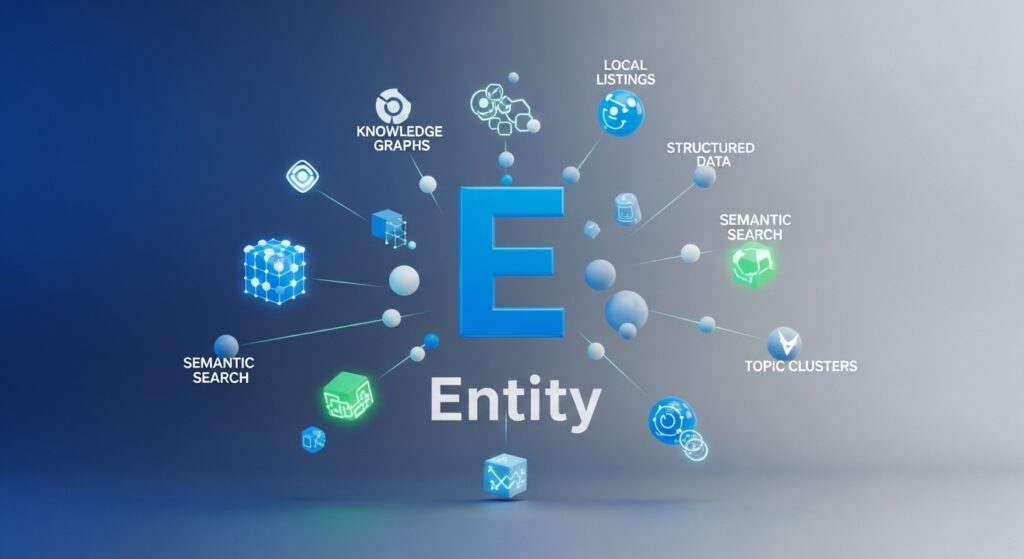
An entity refers to a single, unique, well-defined, and distinguishable thing or concept, a foundational principle in modern SEO for Tourism Website strategies. These range from tangible elements like people, organizations, and products to abstract concepts and creative works. Entities possess defining characteristics such as size, color, and duration, but the defining feature is that entities exist in relation to other things.
From a content perspective, entities become well-defined by referencing other related things. Specifically, an entity only exists when it appears in an entity catalog, which assigns a unique ID to each entity. Wikipedia represents the most well-known database of entities, but any catalog works for entity identification.
The distinction between entities and keywords matters. Keywords are words or phrases searchers use in queries, and historically, search engines ranked pages using keyword matching. However, lexical search presented challenges. Keywords tend to be ambiguous because certain words carry multiple meanings. For instance, “Java” can refer to either the programming language or the island of Indonesia. Different languages phrase the same things differently. The term “rebord de fenêtre” in French translates directly to “edge of window” in English, but actually refers to a windowsill.
Entities, in contrast, are universally understood concepts not bounded by language or ambiguity. They represent broader topics from which keywords stem, distinguished through their relation to other things. Entities carry an additional layer of context, providing greater clarity to search engines.
How search engines use entities to understand content
Search engines analyze concepts and meanings within user queries through a semantic approach. They identify relevant pages that answer the entities in question with greater context and accuracy. Google expanded from 570 million entities and 18 billion facts to 800 billion facts and 8 billion entities in less than 10 years.
Entities operate primarily in the early pipeline stages, during entity recognition, retrieval, and deeper understanding phases. Google evaluates whether an entity is prominent enough to justify retrieval through entity salience, which refers to how central a recognized entity is within a document relative to other entities. This analysis determines which entities define the main topic and context.
Why entity discovery impacts your rankings
Entity-derived features help systems detect near-duplicate content, identify novel contributions, and avoid redundant results. When you define entities within your content through structured data, you structure information in a format search engines understand. This contextual understanding allows search engines to display your content for a broader range of relevant queries, expanding your site’s visibility and attracting a more qualified audience. For SEO for Tourism Website projects, recognizing location entities, attraction entities, and their relationships becomes particularly valuable for building topical authority.

Primary Tools and Data Sources for Finding Entities
Google’s Natural Language API
Several specialized tools extract entities from content with varying levels of sophistication. Google’s Natural Language API performs entity analysis by inspecting text associated with known entities and returning detailed information about them. To identify entities, you make a POST request to documents:analyzeEntities using REST-based commands. Successful requests return responses in JSON format.
The API provides entity names, types (PERSON, ORGANIZATION, LOCATION, EVENT, etc.), and salience scores ranging from 0 to 1 that indicate how central each entity is to the overall text. Moreover, responses include metadata such as Wikipedia URLs and Knowledge Graph Machine IDs (KGMIDs), which connect extracted entities to Google’s knowledge base.
Knowledge Graph databases (Wikipedia, Wikidata)
Wikipedia and Wikidata serve as foundational entity databases for SEO work. Wikidata’s knowledge graph includes over 750 million statements on 61 million items. The platform contains items for over 1.1 million genes, 940 thousand proteins, 150 thousand chemical compounds, and 16 thousand diseases. Both databases provide structured, queryable entity information through SPARQL interfaces.
SEO platforms with entity extraction (InLinks, SurferSEO, Clearscope)
InLinks analyzes content using a proprietary knowledge graph and automates schema markup to communicate entities to search engines. SurferSEO’s Topics feature analyzes top-ranking pages and benchmarks your article against their entity coverage. The platform provides NLP keyword and entity recommendations within its interface. Clearscope scans the top 30 search results using both Google’s NLP and IBM Watson algorithms to isolate phrases unique to entities most likely to rank.
Entity explorer tools and frameworks
Diffbot combines web-wide crawling with a massive pre-built Knowledge Graph containing billions of entities. Hugging Face Inference Endpoints allows deployment of custom Named Entity Recognition models from their model hub.
Free vs paid entity research tools
Google search features offer free entity discovery through autocomplete suggestions, People Also Ask boxes, and People Also Search For sections. Paid enterprise APIs provide deeper analysis with entity sentiment scoring and automated extraction pipelines.
Manual Methods to Discover Entities for Your Content
Manual discovery complements automated extraction when you need granular control over entity selection. These methods reveal patterns automated tools might miss.
Analyzing competitor content for entity patterns
Use NLP APIs to extract named entities from competitor pages that rank for your target keywords. Analyze their backlink anchor text for entity mentions and review their schema markup to identify explicitly marked entities. Map which entities dominate their content strategy and where coverage gaps exist despite apparent keyword targeting. For SEO for Tourism Website projects, this reveals which destination entities, attraction entities, and activity entities competitors prioritize.
Using Google search features (People Also Ask, autocomplete)
People Also Ask boxes appear in over 80% of English searches and dynamically expand with each click. These questions reflect actual user search patterns after initial queries. For autocomplete research, type your keyword then add each letter of the alphabet to discover long-tail entity variations. The underscore character in phrases like “chicago _ photographer” reveals entity completions Google suggests.
Extracting entities from Wikipedia pages
Wikipedia list pages contain over 700k extractable entities not represented as individual pages. These pages use enumeration or table layouts where subject entities appear in structured patterns. Extract type information, nationality, and genre details from list titles and categories.
Identifying entity types and salience scores
Salience scores range from 0 to 1, measuring how central each entity is to your content. Higher scores indicate greater entity prominence within the analyzed text.

How to Validate and Organize Your Entity List
Once you extract entities, filtering them for relevance becomes the next critical step. Raw entity lists often contain noise that dilutes your content’s focus.
Checking entity relevance to your target topic
Compare extracted entities against your core topic using salience scores as an initial filter. Entities with higher salience demonstrate stronger centrality to your content. Cross-reference entity lists with Knowledge Graph databases like Wikidata to verify they exist as recognized concepts. For instance, if writing about Cusco, entities like Machu Picchu and Sacred Valley should appear with strong connections.
Building entity relationship maps
Entity relationship diagrams visualize how concepts connect within your content structure. Map entities as nouns, attributes as descriptive properties, and relationships as verbs linking them together. These diagrams identify which entities relate through one-to-one, one-to-many, or many-to-many patterns.
Documenting entity clusters for content planning
Build topic clusters around a central entity by creating one pillar page as the hub. Supporting pages should reinforce the same entity from different angles and link back to the hub with consistent anchor text. Internal linking structures show search engines how your content connects semantically.
Using entity data for SEO for Tourism Website optimization
Tourism sites benefit from defining destination entities with clear relationships to attractions, routes, and local experiences. Link hotel pages to nearby landmarks and tourism authorities to strengthen your entity graph. Schema markup with TouristDestination and TouristAttraction types helps search engines interpret your hierarchical content structure accurately.
Conclusion
Entity optimization has become essential for modern SEO success. We’ve shown you the tools, manual methods, and validation techniques you need to identify and organize entities effectively. Start by analyzing your existing content with Google’s Natural Language API or free search features, then build entity clusters around your core topics. When you structure content around well-defined entities and their relationships, search engines will better understand your expertise and reward you with stronger rankings.