

Search engine optimization is a complex field that relies heavily on data, precision, and efficiency. As search engines grow more sophisticated, so must the tools and techniques used to master them. This guide explores a critical concept for modern marketers by explaining how can Python be used for SEO in real-world scenarios. By leveraging this powerful programming language, you can unlock unparalleled levels of automation, data analysis, and technical insight.
At RankZol, we specialize in helping businesses automate these intricate SEO tasks to achieve scalable and impactful results. The true power lies in using Python for SEO automation, deep data analysis, and robust technical SEO enhancements.
In this guide, we will walk through how python simplifies technical audits, enhances keyword research, supports content optimization and powers advanced reporting, giving you a complete understanding of its value in today’s SEO landscape.
What Makes Python a Powerful Tool for SEO Automation?
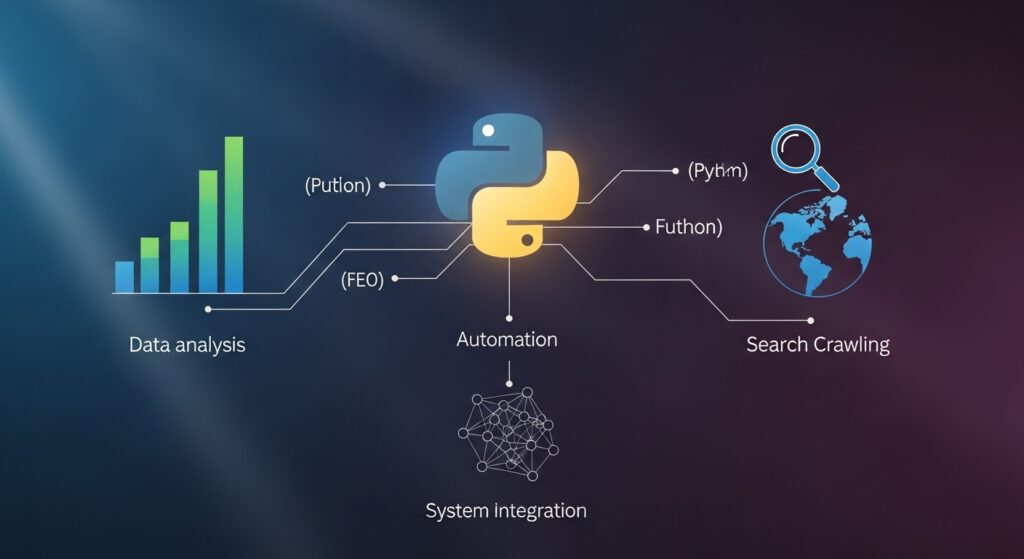
Python has become a favorite in digital marketing for its simplicity, extensive libraries, and versatility. Its straightforward syntax allows even those with limited programming experience to begin creating powerful python for SEO automation scripts. The primary benefit of using Python in SEO is its ability to handle repetitive, time-consuming tasks with speed and precision. This frees up valuable human resources to focus on strategy and creative problem-solving rather than manual data collection and processing.
When you use Python, you can improve your entire SEO workflow. Tasks that once took hours or even days like crawling a large site for errors or pulling keyword data from multiple sources can be completed in minutes. This acceleration does not come at the cost of accuracy. Automation reduces the risk of human error, leading to more reliable data. As your SEO needs grow, Python scripts can be easily scaled to handle larger websites and more complex datasets, making it an ideal solution for businesses of all sizes. The availability of specialized python SEO tools and libraries further enhances its capabilities.
Here are a few examples of what Python can automate in your SEO workflow:
- Large-scale website crawling
- Bulk keyword data extraction
- Technical audits and error detection
- SERP scraping and result tracking
- Competitor comparison and data aggregation
- Content and metadata extraction across thousands of URLs
Furthermore, integrating python for SEO automation allows for the creation of customized solutions tailored to specific business needs. Instead of relying on off-the-shelf software that may not perfectly fit your strategy, you can build scripts that perform exact functions. This includes everything from monitoring SERP volatility to performing large-scale seo data extraction. This custom approach, which we at RankZol champion, ensures that your SEO efforts are both efficient and highly effective, providing a significant competitive advantage.
How Python Helps With Technical SEO Analysis?
Technical SEO is the backbone of every successful optimization strategy. For search engines to properly understand and rank your content, your website must be fully crawlable and free of technical barriers. Python plays a major role here by enabling deep python technical SEO analysis. With the help of automated scripts, you can perform website crawling with Python to simulate how search engine bots interact with your site and uncover issues that affect visibility.
This automated crawling makes it easy to detect problems that are often missed during manual checks. Python scripts can identify broken links, verify redirects, validate structured data, and flag pages with slow load times. This type of detailed SEO data extraction gives you a clear picture of your site’s overall technical health. At RankZol, we rely on Python-driven audits to ensure every element of the site is properly optimized and ready for indexing.
This is exactly where Python becomes extremely powerful, as it allows you to analyze a website on a technical level with complete accuracy and automation.
Below are two of the most effective ways Python is used for technical SEO.
Building Custom SEO Audit Scripts with Python
One of Python’s most powerful advantages in technical SEO is its ability to create fully customized audit scripts tailored to your exact needs. Instead of relying solely on standard SEO tools, Python allows you to build scripts that crawl your website and generate precise reports on the elements that matter most to your strategy.
For example, a custom audit script can:
- Detect missing or duplicate title tags and meta descriptions
- Identify pages with thin or low-quality content
- Check status codes for all URLs across the site
- Review header structures, internal links, and canonical tags
This level of customization helps you create a clear, prioritized action plan based on real data, not assumptions.
Performing Log File Analysis with Python
Beyond crawling, Python is exceptionally valuable for analyzing server log files—an area many SEOs overlook. Log files record how search engine bots behave on your site, but they are often too large and complex to examine manually. Python quickly processes these large files, giving you insights that drive better indexing and crawl efficiency.
With Python log analysis, you can:
- Understand how your crawl budget is being used
- Identify which pages Googlebot visits most frequently
- Detect crawl errors, loops, or bottlenecks
- Locate orphan pages that receive no crawler attention
These insights are crucial for enhancing site structure, improving crawlability, and ensuring that your most important pages are indexed consistently.
Python for Keyword Research & Data Processing

Keyword research is a cornerstone of SEO, but it often involves processing vast amounts of data from various tools. Python streamlines this entire process, from data gathering to analysis. You can use scripts to automate seo keyword analysis python tasks, such as pulling suggestions from Google Keyword Planner, Ahrefs or Semrush via their APIs. This eliminates manual exporting and collating of spreadsheets, saving significant time.
Beyond simple data collection, Python excels at processing and refining keyword lists. For instance, data cleaning with python is a powerful feature that allows you to remove duplicates, filter out irrelevant terms, and standardize formatting across different datasets. One of the most advanced applications is keyword clustering with python. Using Natural Language Processing (NLP) algorithms, you can group thousands of keywords into topically relevant clusters, which is invaluable for structuring website content and planning targeted campaigns.
Automating Keyword Clusters with Python NLP
Manual keyword grouping is subjective and time-consuming. Python automates this with scientific precision. By employing NLP techniques like TF-IDF (Term Frequency-Inverse Document Frequency), you can analyze the relevance of keywords to one another. Algorithms based on cosine similarity can then measure the semantic relationship between terms, grouping them into logical clusters. This data-driven approach ensures that your content architecture aligns with how users search and how search engines understand topics.
Python for SERP Data Extraction
Understanding the search engine results pages (SERPs) for your target keywords is critical for outranking competitors. Python scripts can automate the process of scraping SERP data at scale. This allows you to collect information on who is ranking, what types of content are performing well (e.g., videos, articles, product pages), and the common features of top-ranking pages. This insight helps you tailor your content strategy to meet user intent and SERP expectations.
Python for Backlink Analysis & Competitor Research
Backlinks remain a powerful ranking signal, and analyzing your own and your competitors’ backlink profiles is essential. Python can automate the collection and analysis of this data. By connecting to the APIs of tools like Ahrefs, Moz or Semrush, you can create a custom python backlink checker that pulls comprehensive data into a single dashboard.
This allows for sophisticated seo competitor analysis with python. You can compare your backlink profile against multiple competitors, identify “link gaps” (websites linking to competitors but not to you), and analyze the quality of referring domains. A python link explorer script can also categorize links by type, authority, and relevance, providing a much clearer picture of your link-building opportunities and risks. This data-driven approach transforms link building from a guessing game into a strategic initiative.
Monitoring Backlink Growth with Python Scripts
Your backlink profile is not static. It’s crucial to monitor changes over time. Python scripts can be scheduled to run at regular intervals to track new and lost backlinks. This automated monitoring allows you to quickly react to a sudden drop in links or to reach out and thank a website owner for a valuable new link, fostering positive relationships.
Detecting Toxic Backlinks Using Python
Not all backlinks are beneficial. A large number of low-quality or spammy links can harm your site’s authority. Manually sifting through thousands of backlinks is an arduous task. Python can automate this by filtering links based on spam scores, domain authority metrics, and other quality indicators. You can even use machine learning models to classify links as toxic or safe, making the disavow process faster and more accurate.
How Python Supports Content Optimization for SEO?
High-quality, relevant content is the heart of SEO. Python, particularly with its NLP capabilities, offers powerful ways to optimize content at scale. Using Python for content optimization python strategies allows you to move beyond basic keyword placement and into a deeper understanding of language and context. Scripts can perform automated content gap analysis by scraping top-ranking competitor pages and identifying subtopics and keywords you may have missed.
Moreover, Python can be used for sophisticated text analysis for seo. Scripts can analyze your content for keyword density, check for readability scores, and compare your content length against the average of the top-ranking pages. With python nlp seo libraries like NLTK or spaCy, you can even perform sentiment analysis or entity extraction to better understand the nuances of the content that performs best in your niche.
Python for On-Page Optimization Insights
Python scripts are excellent for auditing on-page SEO elements across your entire website. A script can quickly crawl every page and extract key information such as title tags, meta descriptions, header structures (H1, H2, etc.), image alt text, and internal link counts. This data can be compiled into a single report, making it easy to spot inconsistencies or optimization opportunities that would be tedious to find manually.
Python for Generating Content Briefs
Creating effective content briefs for writers is a time-consuming but critical task. Python can automate much of this process. A script can be built to scrape the top-ranking articles for a target keyword and extract common themes, frequently asked questions (from “People Also Ask” boxes), and the header structures of competitor articles. This provides a data-backed foundation for your writers, ensuring the content they produce is comprehensive and aligned with what is already ranking well.
Automating SEO Reporting with Python Dashboards
Reporting is essential for demonstrating the value of SEO, but it can be one of the most repetitive tasks. Python can completely automate the creation of SEO reports and dashboards. By connecting to the APIs of Google Analytics 4, Google Search Console, Ahrefs, and other platforms, you can build scripts for seo reporting automation that pull all of your key metrics into one place.
This process significantly reduces the time spent on manual data collection and report building, while also increasing accuracy. The data can then be fed into visualization libraries like Matplotlib or Plotly to create custom python seo dashboards. These dashboards can display trends in organic traffic, keyword rankings, backlink growth, and technical health over time. For our clients, RankZol develops these custom dashboards to provide clear, real-time insights into campaign performance.
Real-World SEO Tasks You Can Automate With Python

The applications of Python in SEO are vast. By leveraging seo scripting python techniques, you can build custom python seo workflows to automate a wide range of tasks. Here is a list of practical, high-impact automated seo tasks that can be managed with Python:
- Crawl Error Detection: Automatically crawl your site to find and report on 404 errors and other server issues.
- Indexing Issue Monitoring: Use scripts to check if important pages are indexed by Google.
- Competitor Ranking Analysis: Track your competitors’ keyword rankings over time to spot opportunities and threats.
- Keyword Clustering: Group large sets of keywords into topically relevant clusters for content strategy.
- Backlink Auditing: Automate the process of pulling and analyzing your backlink profile for quality and toxicity.
- SERP Scraping: Extract data from search results pages to analyze ranking factors and content types.
- Technical Health Score Automation: Create a custom script that regularly checks key technical SEO metrics and generates an overall health score for your site.
Is Python Necessary for Modern SEO?
While it’s possible to perform SEO without knowing how to code, understanding why use python for seo reveals its immense value in achieving a competitive edge. For small websites with limited needs, standard SEO tools may suffice. However, for agencies, large enterprises, and technical SEO specialists managing complex websites, Python becomes nearly indispensable. The benefits of python in seo are centered on scalability, customization, and efficiency.
The main value of seo automation benefits lies in freeing up your most valuable resource: your team’s time. When SEO professionals are not bogged down by manual, repetitive work, they can focus on high-level strategy, creativity, and adapting to the ever-changing search landscape. Python empowers teams to work smarter, not just harder. RankZol harness the power of Python to deliver scalable SEO success for our clients, turning complex data into actionable strategies that drive real growth.
Closing Remarks
In conclusion, Python is transforming SEO from a practice of manual checks and balances into a data-driven science. It allows for deeper insights, greater efficiency, and a level of customization that traditional tools simply cannot match. From technical audits and keyword research to content optimization and reporting, Python automates and enhances nearly every part of the SEO workflow.
For businesses serious about scaling their online presence and achieving long-term results, adopting a Python-powered SEO approach is no longer optional it is a strategic advantage. RankZol help brands harness this power by building automated, accurate, and scalable Python-driven SEO systems. If you want to understand more about how can Python be used for SEO to benefit your business, our team is ready to guide you.
FAQ’s
How can Python be used for SEO?
Python can be used for SEO by automating repetitive tasks, analyzing large datasets, performing technical audits, scraping SERP data, optimizing content, clustering keywords, and building custom dashboards. It helps improve accuracy, speed, and decision-making while reducing manual work.
Is Python necessary for modern SEO?
Python isn’t mandatory, but it provides a strong competitive advantage by simplifying technical tasks and enabling automation that traditional tools cannot perform.
Do I need to be a programmer to use Python for SEO?
No. Basic scripts can be run with minimal knowledge, and many SEO professionals use pre-built scripts or collaborate with technical teams to implement Python-powered solutions.
What SEO tasks can Python automate?
Python can automate crawling, indexing checks, backlink auditing, keyword clustering, content gap analysis, SERP scraping, reporting, and data cleaning.
Can Python help with technical SEO audits?
Yes. Python is excellent for technical SEO audits. It can detect broken links, crawl errors, redirect issues, structured data problems, and page performance issues across large websites.
How does Python improve keyword research?
Python enhances keyword research by extracting data via APIs, removing duplicates, clustering keywords using NLP, and analyzing search intent at scale.
Can Python analyze competitor websites?
Absolutely. Python can scrape competitor data, compare backlink profiles, analyze ranking patterns, and identify content and keyword gaps.
How does Python support log file analysis?
Python can parse massive server log files to reveal how Googlebot crawls your site, which pages get attention, and where crawl budget is being wasted.
Can Python help improve site indexing?
Yes. Python scripts can monitor indexed vs. non-indexed pages, identify orphan pages, and detect issues blocking pages from appearing in search results.
How can Python help with backlink analysis?
Python can pull backlink data from tools like Ahrefs or Semrush, identify toxic backlinks, detect new or lost backlinks, and compare profiles with competitors.
Can Python be used for content optimization?
Yes. Python’s NLP libraries help analyze keyword density, readability, topical coverage, sentiment, and content gaps to refine your on-page SEO strategy.
What Python libraries are useful for SEO tasks?
Popular libraries include BeautifulSoup, Scrapy, Selenium, Pandas, NumPy, spaCy, NLTK, Matplotlib, and Requests.
Can Python automate SEO reporting?
Yes. Python can connect to Google Analytics, Search Console, Ahrefs, and other APIs to generate automated dashboards and real-time performance reports.
Is Python suitable for large website SEO?
Python is ideal for large or enterprise-level websites because it can crawl thousands of URLs, process heavy data, and automate operations at scale.
How can RankZol help with Python-powered SEO?
RankZol builds customized Python workflows that automate technical audits, keyword research, reporting, and competitor analysis. Their data-driven approach helps businesses scale SEO performance efficiently.