Did you know that 87% of shoppers begin their buying journey online, even if they eventually make their purchase offline? This statistic alone underscores why affordable SEO services for small businesses have become crucial, a need further amplified by the ongoing shift illustrated in discussions of How AI Browsers Are Challenging Google’s Credibility, for survival in today’s digital landscape.
Despite the proven value of SEO delivering up to 400% ROI within two years many small businesses struggle to justify the typical $1,500+ monthly investment that SEO services often require. However, the good news is that affordable SEO services for small businesses are now bridging the gap between cheap providers and premium agencies charging $1,500-5,000 per month.
As we navigate this evolving digital marketing terrain, a new challenge has emerged: AI browsers. These sophisticated tools are fundamentally changing how people search for information online, causing significant disruption to Google’s long-established dominance and credibility. In fact, over 50% of users now discover new brands or products after a search, highlighting both the opportunity and the shifting dynamics at play.
In this article, we’ll explore how AI browsers are reshaping the SEO landscape, why Google’s position is being questioned, and most importantly, how small businesses can adapt their SEO strategies without breaking the bank.
The rise of AI browsers and their growing influence
The internet landscape is rapidly changing with AI browsers emerging as powerful alternatives to traditional search engines. Currently, about 50% of Google searches already display AI summaries a figure projected to reach more than 75% by 2028. This shift represents a fundamental change in how users discover information online and presents new challenges for businesses investing in affordable SEO services for small businesses.
What makes AI browsers different from search engines?
AI browsers go beyond simply displaying web pages. Unlike traditional search engines that return lists of links, AI browsers actively assist users by summarizing content, answering questions directly, and even performing tasks autonomously. These tools fall into two main categories:
- Smart helpers – These add AI features like chat and summarization while users maintain control of browsing (examples: Arc Max, Brave Leo, Microsoft Edge Copilot)
- AI agents – These can browse websites independently and complete complex tasks without constant guidance (examples: Perplexity Comet, Strawberry Browser)
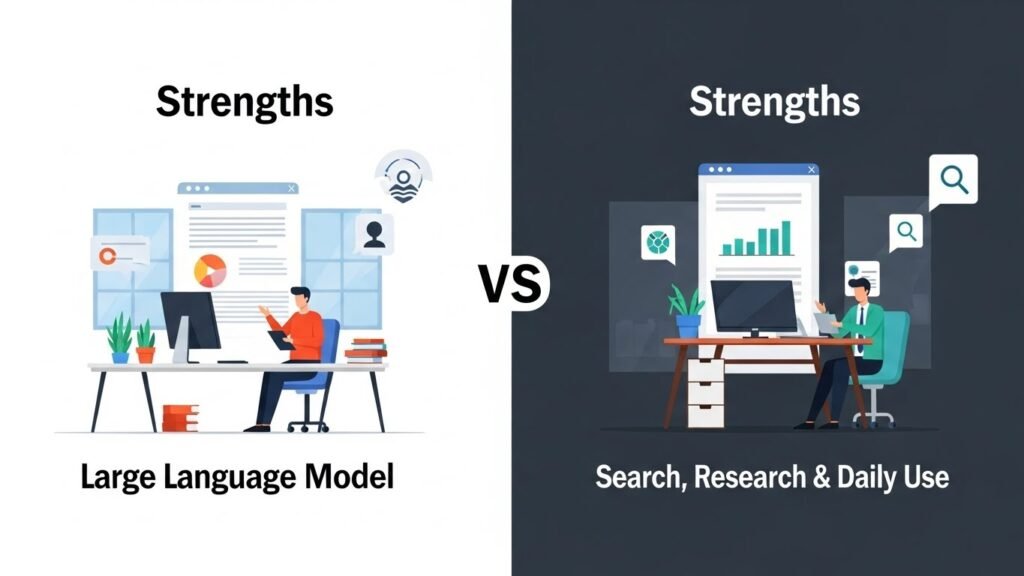
The key distinction is that search engines primarily retrieve existing content, whereas AI browsers generate new, synthesized responses based on multiple sources.

How users interact with AI-generated answers
User behavior with AI browsers differs dramatically from traditional search patterns. When presented with AI-generated answers, 70% of users don’t scroll beyond the first third of the response. Additionally, the click-through rate drops by two-thirds when AI overviews appear.
This represents a significant shift in information consumption. Rather than visiting multiple websites, users increasingly trust the AI’s summaries as authoritative sources. Consequently, 44% of AI-powered search users now consider it their primary source of insight surpassing traditional search (31%).
Examples of AI browsers gaining traction
Several AI browsers are rapidly gaining market share:
- Perplexity Comet – Navigates websites autonomously and completes multi-step tasks across different sources
- Brave Leo – Works immediately without signup, providing accurate summaries and technical analysis
- ChatGPT Atlas – Brings ChatGPT directly into the browser with automated task capabilities, now attracting 800 million weekly active users
- Opera Aria – One of the first AI browsers launched in 2023
For small businesses utilizing affordable SEO services, understanding these emerging platforms is becoming essential, as unprepared brands may experience 20-50% decline in traffic from traditional search channels.
Why Google’s credibility is being questioned
For decades, Google has been synonymous with internet search. Yet, as AI browsers gain momentum, several key factors have begun to erode the search giant’s once-unquestioned authority.
Over-reliance on ads and sponsored content
Google’s search results pages have gradually become overwhelmed with advertisements. Currently, up to 45% of prime screen real estate is dedicated to paid placements on mobile devices. This shift toward commercialization has fundamentally altered the user experience.
Notably, first-page organic visibility has decreased by 37% since 2020 as paid results consume more space. For small businesses seeking affordable SEO services, this creates a challenging scenario where visibility increasingly depends on advertising budgets rather than content quality.
Algorithm updates causing volatility
Google’s frequent algorithm changes have created significant instability for website owners. Since 2021, core updates have occurred approximately every 3-4 months, each potentially reshuffling search rankings dramatically.
These updates particularly impact small businesses without dedicated SEO teams. After major algorithm changes, traffic fluctuations of 30-50% are common among small business websites. Such unpredictability makes it difficult for companies to maintain consistent visibility, especially those utilizing affordable SEO services for small businesses with limited resources for constant adaptation.
User frustration with irrelevant results
Perhaps most concerning is the growing dissatisfaction with search quality itself. Recent surveys indicate that 62% of users believe Google’s results have become less relevant over time, with nearly 40% reporting they need to refine searches multiple times to find useful information.
This frustration stems partly from content designed primarily to rank well rather than provide value. The rise of AI-generated content has further complicated matters, with some estimates suggesting that low-quality AI articles now constitute up to 25% of search results for certain queries.
For small business owners, this creates a paradox: investing in affordable SEO services becomes both more necessary yet potentially less effective as the very platform they’re optimizing for loses user trust.
How SEO is evolving in response to AI
As AI reshapes the search landscape, SEO practices must fundamentally transform to remain effective. Traditional optimization tactics no longer deliver the same results in this new environment where user behavior and search algorithms have dramatically changed.
From keyword targeting to intent optimization
The days of keyword-focused optimization are fading fast. Search has evolved from simple keyword matching to understanding the underlying purpose behind queries. According to recent data, roughly 60% of searches now result in zero clicks as AI-generated answers provide everything users need right on the search results page. For businesses using affordable SEO services, this means shifting focus toward:
- Creating content that addresses the “why” behind searches
- Organizing information in clear, structured formats
- Developing content clusters around topics rather than isolated keywords
The role of zero-click searches and AI summaries
Zero-click searches have reduced organic web traffic by an estimated 15-25%. AI Overviews peaked at nearly 25% of keywords in July 2025 before settling at 15.69% by November. Furthermore, these AI-generated summaries are increasingly targeting commercial intent queries, with commercial searches triggering AI Overviews jumping from 8.15% to 18.57%.
Why backlinks and domain authority may matter less
Contrary to some predictions, backlinks remain crucial but their role is evolving. AI systems interpret backlinks differently, focusing more on relevance and contextual authority than pure quantity or domain scores. Subsequently, successful SEO now requires earning mentions from trusted publications relevant to your industry rather than accumulating links from high-authority but irrelevant sources.

Future-proofing your SEO strategy
In today’s AI-driven search environment, staying ahead requires strategic adaptation rather than reactive measures. Let me share proven approaches to maintain visibility regardless of how search evolves.
Investing in high-quality, expert-driven content
Quality content remains paramount as AI can only cite what exists and trusts. Strong E-E-A-T signals (Experience, Expertise, Authoritativeness, Trustworthiness) are more vital than ever for visibility. Content with original research enjoys 30-40% higher AI visibility, while structured content is 40% more likely to be cited by AI. Include expert quotes with credentials and verifiable claims backed by statistics to strengthen trust signals.
Using schema markup and structured data
Schema markup is no longer optional but foundational for modern SEO. This structured data helps AI systems accurately interpret your content, with case studies showing 25% higher click-through rates for pages using schema markup. Indeed, 72% of sites on Google’s first page use schema. Implementation enables rich results, which Nestlé found drove 82% higher click-through rates than standard listings.
Focusing on user experience and site performance
Site speed directly impacts conversions improving page load time by just one second can increase conversions by 2%. Moreover, bounce rates increase by 32% when page load times increase from 1-3 seconds. Core Web Vitals (measuring load performance, interactivity, and visual stability) are now crucial ranking factors that AI browsers consider when evaluating content quality.
Choosing affordable SEO services that understand AI trends
Look for affordable SEO services for small businesses that offer AI-specific optimization like Generative Engine Optimization (GEO) and Answer Engine Optimization (AEO). Effective providers should evaluate your visibility across AI platforms like ChatGPT and Perplexity while delivering customizable content plans that remain compliant with AI search requirements.

Conclusion
The SEO landscape stands at a pivotal crossroads as AI browsers continue to reshape how users find information online. Throughout this article, we’ve seen how these intelligent tools fundamentally challenge Google’s long-established dominance by offering more direct, synthesized answers rather than lists of links. Consequently, small businesses must adapt or risk becoming invisible in this new search paradigm.
AI browsers represent both a challenge and an opportunity for businesses seeking affordable SEO services. While zero-click searches might reduce traditional website traffic, companies that embrace structured data, expert-driven content, and user experience optimization will still thrive. Above all, understanding user intent rather than simply targeting keywords has become essential for visibility.
Google’s credibility issues stemming from ad saturation, algorithm volatility, and declining result quality have undoubtedly accelerated this shift. Nevertheless, this evolution doesn’t signal the death of SEO but rather its transformation. Small businesses that partner with forward-thinking, affordable SEO services will navigate these changes successfully.
The future belongs to businesses that prioritize genuine expertise and user value over mechanical optimization tactics. Therefore, as you develop your digital marketing strategy, focus on creating content that genuinely helps users, structure it properly with schema markup, and ensure your site delivers exceptional performance. Eventually, these fundamentals will serve you well regardless of whether users find you through Google or emerging AI browsers.
Though the road ahead may seem challenging, especially for small businesses with limited resources, affordable SEO services that understand these emerging trends can provide tremendous competitive advantage. At this point, the businesses that adapt quickly will not only survive but thrive in the AI-driven search landscape that continues to unfold before us.
Frequently Asked Questions (FAQs)
1. What exactly is an AI browser and how is it different from Google Chrome or Safari?
AI browsers aren’t just containers for viewing web pages they’re intelligent assistants built directly into your browsing experience. While traditional browsers like Chrome or Safari simply display websites, AI browsers actively help you by summarizing articles, answering questions without visiting multiple sites, and even completing tasks autonomously. They fall into two categories: smart helpers that add AI features while you maintain control, and AI agents that can browse independently and handle complex multi-step tasks. Think of it as the difference between a librarian pointing you to books versus an expert reading those books for you and synthesizing the key insights into one comprehensive answer.
2. Why are people starting to trust AI-generated answers more than Google search results?
User trust is shifting because AI browsers provide immediate, synthesized answers rather than forcing people to click through ten different blue links. Recent data shows that 44% of AI-powered search users now consider it their primary source of insight, surpassing traditional search at 31%. This preference stems from several factors: Google’s results have become cluttered with ads occupying up to 45% of mobile screen space, 62% of users believe Google’s results have grown less relevant over time, and people are tired of refining searches multiple times to find useful information. AI browsers cut through the noise by delivering direct, conversational answers that feel more trustworthy than wading through sponsored content and SEO-optimized articles.
3. What are zero-click searches and why should small business owners care about them?
Zero-click searches occur when users get their answer directly on the search results page without clicking through to any website. Currently, about 60% of searches end without a click because AI-generated summaries provide everything users need. For small businesses, this is a double-edged sword it means you could lose 15-25% of your organic web traffic even if your content is excellent. However, it also creates opportunity: if your content gets cited in these AI summaries, you gain massive brand visibility without users even visiting your site. The key is optimizing for being the source AI browsers trust and reference, which requires structured data, expert-driven content, and clear answers to common questions in your industry.
4. Is Google actually losing its dominance, or is this just hype?
The shift is real and measurable, not just speculation. Currently, 50% of Google searches already display AI summaries, with projections reaching 75% by 2028. AI browsers like ChatGPT now have 800 million weekly active users, while platforms like Perplexity are rapidly gaining market share. First-page organic visibility on Google has decreased by 37% since 2020 as paid results consume more space. Additionally, brands unprepared for AI browsers are experiencing 20-50% declines in traffic from traditional search channels. While Google isn’t disappearing overnight, its monopoly on search behavior is genuinely eroding as users discover alternatives that better meet their needs for quick, reliable information without ad clutter.
5. Should small businesses stop investing in traditional SEO altogether?
Absolutely not but the approach needs evolution, not abandonment. SEO isn’t dying; it’s transforming. The fundamentals still matter: quality content, site performance, user experience, and authority building remain crucial. What’s changing is how these elements are evaluated. Instead of keyword-focused optimization, businesses need intent-based content that answers real questions. Rather than chasing backlink quantity, focus on relevant mentions from trusted industry sources. Traditional SEO practices like schema markup are now more important than ever because AI browsers rely heavily on structured data to understand and cite content. Think of it as upgrading your strategy rather than starting from scratch many principles remain the same, but the execution must adapt.