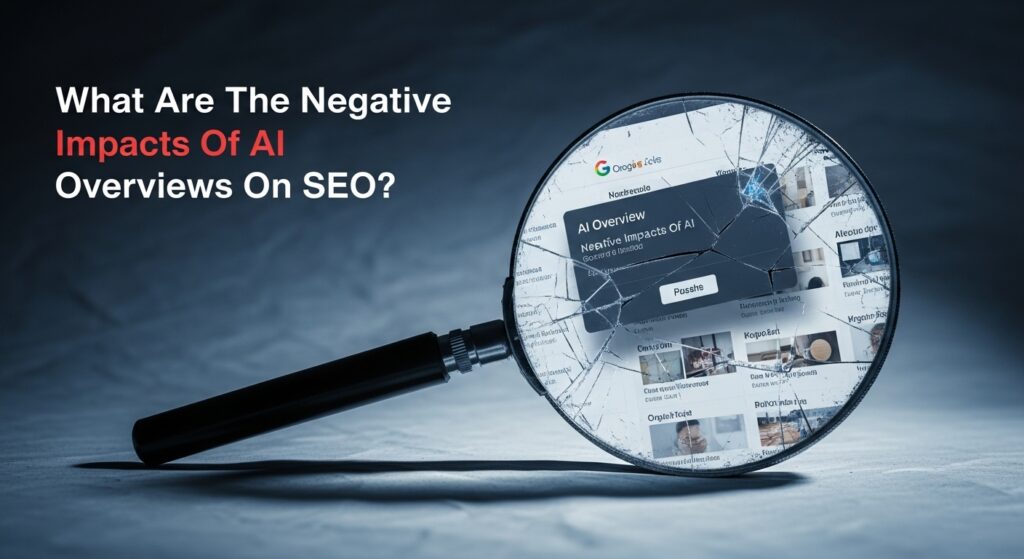
Artificial intelligence is rapidly changing how people discover and consume information and Google’s AI Overviews are leading this change. These AI-generated summaries now appear at the top of search results, instantly providing users with direct answers instead of a list of website links. While this improves user convenience, it raises an important question for website owners and marketers that what are the negative impacts of AI overviews on SEO?
In this article, we’ll uncover how AI Overviews are reshaping search behavior, reducing website traffic, challenging traditional SEO strategies and what this means for businesses and creators alike.
What Are AI Overviews?
AI Overviews are Google’s AI-driven summaries that provide quick, synthesized answers directly in search results. Instead of showing multiple website links, Google’s AI now gathers information from across the web and displays a ready-made response.
Although AI Overviews aim to simplify search experiences, they also bring several major drawbacks for businesses, publishers, and SEO professionals.
Negative Impacts of AI Overviews On SEO

Below are the major negative impacts of AI Overviews on SEO that are reshaping digital marketing and forcing website owners to rethink their optimization strategies.
1. Reduced Click-Through Rates (CTR)
AI overviews are designed to provide users with instant answers to their queries, often without requiring them to click on any website. While this improves user experience, it significantly reduces the click-through rates (CTR) for websites. CTR is a critical metric in SEO, as it signals to search engines that users find a website relevant and valuable. A decline in CTR can lead to lower rankings over time.
For example, if a user searches for “how to bake a cake,” an AI overview might display the entire recipe in the search results. This eliminates the need for the user to visit the original website, depriving it of valuable traffic. Over time, this trend can erode the visibility and authority of even the most well-optimized websites.
2. Decline in Organic Traffic
One of the most significant challenges in understanding what are the negative impacts of AI overviews on SEO is the sharp decline in organic traffic. Organic traffic is the lifeblood of most websites, especially those that rely on ad revenue, affiliate marketing, or e-commerce sales. AI overviews bypass traditional search results by offering users instant answers, which means fewer users click through to the actual websites.
For instance, news websites often experience a drop in traffic when AI tools summarize their articles. Instead of visiting the website to read the full story, users consume the summary provided by the AI. This not only affects traffic but also reduces opportunities for user engagement, such as comments, shares, and subscriptions.
3. Content Ownership and Attribution Issues
AI overviews frequently summarize content without proper attribution to the original creators. This raises ethical concerns about intellectual property and deprives content creators of the recognition and traffic they deserve. For example, a blog post or article may be summarized by AI without linking back to the original website, leaving the creator without credit or visibility.
This issue is particularly problematic for smaller websites and independent creators who rely on traffic to sustain their operations. Without proper attribution, their hard work goes unnoticed, and they lose the opportunity to build their brand and audience.
4. Increased Competition for Featured Content
AI overviews prioritize content from authoritative sources, making it harder for smaller websites to compete. This creates an uneven playing field where large platforms dominate search results. Smaller websites and niche blogs often struggle to gain visibility, even if their content is high-quality and relevant.
For example, if a user searches for “best travel destinations,” the AI overview might pull information from large travel websites like Lonely Planet or TripAdvisor, leaving smaller travel blogs out of the picture. Understanding how to compare AI search optimization tools can help businesses adapt to this new reality, but the competition remains fierce and challenging.
5. Potential for Misinformation
AI overviews are not immune to errors. They can generate inaccurate or outdated information, leading to misinformation. This not only affects user trust but also undermines websites that provide accurate and reliable content.
For example, if an AI tool pulls incorrect medical advice from an unreliable source, it can mislead users and potentially cause harm. Meanwhile, websites with accurate information may be overlooked, as users rely on the AI-generated summary instead of verifying the details themselves.
6. Devaluation of Long-Form Content

AI overviews prioritize concise answers, which reduces the value of in-depth, long-form content. This shift discourages content creators from investing time and effort into detailed articles, as users may never engage with them.
For instance, a 2,000-word guide on “how to start a business” may be reduced to a single sentence by AI, leaving the original content underappreciated. This not only affects the creator’s motivation but also limits the depth of information available to users, as creators may opt for shorter, less detailed content to align with AI preferences.
7. Challenges in Optimizing for AI Overviews
Traditional SEO practices may not align with the algorithms used by AI tools. This creates uncertainty for SEO professionals who are unsure how to optimize content for AI-generated summaries. Unlike traditional search engines, AI tools prioritize specific types of content, such as concise answers or structured data, making it harder to predict what will rank.
For example, a website that ranks well for a particular keyword may find its content excluded from AI overviews if it doesn’t meet the AI’s criteria. This forces businesses to invest additional time and resources into developing new strategies, further complicating the SEO landscape.
8. Loss of Brand Visibility
AI overviews often strip away branding elements, presenting information in a generic format. This diminishes a brand’s visibility and authority, making it harder to build trust and loyalty with users.
For example, a brand’s unique content may be summarized without any mention of the brand name, reducing its impact. This is particularly problematic for businesses that rely on their brand identity to differentiate themselves from competitors.
9. Dependence on AI Platforms
Websites are becoming increasingly reliant on AI platforms for visibility. This dependence makes them vulnerable to algorithm changes, which can drastically affect traffic and rankings.
For instance, a sudden update in an AI algorithm could lead to a significant drop in a website’s visibility, leaving businesses scrambling to adapt. This lack of control over how content is presented and ranked adds another layer of complexity to SEO strategies.
10. Monetization Challenges
Finally, one of the most pressing aspects of what are the negative impacts of AI overviews on SEO is the challenge of monetization. Reduced traffic directly impacts ad revenue, affiliate marketing, and e-commerce sales. Smaller businesses and independent bloggers are particularly vulnerable, as they often rely on consistent traffic to sustain their operations.
For example, an e-commerce website that loses traffic to AI-generated product recommendations may see a decline in sales, affecting its bottom line. This makes it crucial for businesses to explore alternative monetization strategies and adapt to the changing landscape.
Conclusion
The rise of AI Overviews has undeniably changed the SEO landscape, but it has also introduced significant challenges. From reduced click-through rates and organic traffic to content ownership issues and monetization struggles, the negative impacts are far-reaching. Understanding what are the negative impacts of AI overviews on SEO is crucial for businesses and content creators to adapt and thrive in this evolving digital environment.
To stay ahead, it’s essential to explore innovative SEO strategies and intelligent tools that align with modern search behavior.Partnering with RankZol, a digital growth company specializing in advanced SEO solutions, can help brands analyze performance, strengthen authority, and sustain visibility in the age of AI-driven search.
By learning how to compare AI search optimization tools, and leveraging RankZol’s expertise, businesses can better navigate these challenges and maintain a strong, competitive online presence.
FAQ’s
What are the negative impacts of AI overviews on SEO?
AI overviews reduce click-through rates (CTR), lower organic traffic, create content ownership issues, increase competition for visibility, spread misinformation, devalue long-form content, challenge traditional SEO strategies, diminish brand visibility, and complicate monetization efforts.
Why do AI overviews cause a decline in organic traffic?
By offering instant answers, AI overviews bypass traditional search results, meaning fewer users visit websites. This reduces organic traffic, which is vital for ad revenue, affiliate marketing, and user engagement.
How do AI overviews increase competition for smaller websites?
AI overviews prioritize content from authoritative sources, making it harder for smaller websites and niche blogs to compete for visibility, even if their content is high-quality.
Can AI overviews spread misinformation?
Yes, AI overviews can generate inaccurate or outdated information by pulling data from unreliable sources, which can mislead users and overshadow credible websites.
How do AI overviews impact long-form content?
AI overviews prioritize concise answers, reducing the value of in-depth, long-form content. This discourages creators from producing detailed articles, as users may never engage with them.
Are traditional SEO strategies effective for AI overviews?
Traditional SEO practices may not align with AI algorithms, making it harder to optimize content for AI-generated summaries. Businesses need to adapt to new strategies to stay competitive.
How do AI overviews affect brand visibility?
AI overviews often strip away branding elements, presenting information generically. This diminishes a brand’s visibility and makes it harder to build trust and loyalty with users.
Why are websites becoming dependent on AI platforms?
Websites rely on AI platforms for visibility, but this dependence makes them vulnerable to algorithm changes, which can drastically affect traffic and rankings.
How do AI overviews impact website monetization?
Reduced traffic from AI overviews directly affects ad revenue, affiliate marketing, and e-commerce sales, making it harder for websites to sustain their operations.
What industries are most affected by AI overviews?
Industries relying on organic traffic, such as news, blogging, e-commerce, and affiliate marketing, are most affected by the reduced visibility and traffic caused by AI overviews.
How can businesses combat the negative impacts of AI overviews?
Businesses can combat these impacts by creating unique, high-quality content, optimizing for AI algorithms, and exploring alternative monetization strategies to reduce reliance on organic traffic.
Are AI overviews here to stay?
Yes, AI overviews are becoming a permanent feature of search engines. Businesses and content creators must adapt their strategies to thrive in this evolving digital landscape.