Why is SEO important for ecommerce in 2026? Even as online shopping grows, search engines remain the primary gateway for consumers. About 93% of all online experiences begin with a search engine, so ranking well is essential. By 2026, the global eCommerce market is projected to exceed trillions of dollars, making discoverability fiercely competitive.
SEO ensures your store stands out by aligning content with user search intent. It helps Google and other search engines understand your website and what content is most important, allowing potential customers to find you when they’re ready to buy.
Below, we are going to share key reasons about importance of choosing SEO for Ecom platforms in 2026. Read on!
Capturing High-Intent Traffic and Conversions
A core reason ecommerce SEO is vital is that it drives high-intent customers. The top organic result on Google garners roughly 30% of all clicks. In practical terms, having your product on page one means thousands of potential buyers see it; if you rank on page two or lower, virtually no one will.
Moreover, online shoppers are goal-oriented — the majority research products before buying. SEO targets these researchers at the moment of intent, guiding them from search to your product pages.
Enhancing Brand Authority and Trust
In 2026, Google’s algorithms reward not just relevance but trust and expertise. The sites that win in 2026 will be those with strong brand recognition and social credibility. Smaller retailers with genuine expertise can outrank larger competitors if they highlight what makes them unique. Search engines now favor businesses that provide authentic, experience-driven content over generic copy.
For eCommerce, this means your site must demonstrate authority in your niche. Detailed product descriptions, informative buying guides, and clear business credentials all help. Showcasing customer reviews and testimonials also builds “experience” signals that enhance credibility.
Tips to Build Trust Through SEO:
- Publish detailed, accurate, and well-written product content.
- Use original photos, demo videos, and product comparisons.
- Highlight brand values, customer guarantees, and return policies.
- Encourage verified customer reviews and testimonials.
- Maintain consistent branding across search, social, and website.
Every high-ranking page reinforces your credibility — customers tend to trust and return to sites they see repeatedly at the top of search results.
Optimizing User Experience and Core Web Vitals
SEO isn’t just about keywords; it’s also about giving users a great experience. Page experience signals such as load speed, mobile-friendliness, interactivity, and visual stability directly affect rankings.
An online store must load quickly, especially on mobile, because shoppers abandon slow sites. Using a content delivery network (CDN) to serve images and minimizing heavy scripts can significantly improve load times on product pages.
Best practices for technical SEO and UX:
- Improve page load speed with compressed images and caching.
- Maintain a clear, intuitive navigation and internal linking.
- Use structured data (schema) for products, reviews, and availability.
- Optimize for mobile-first indexing.
- Secure your site with HTTPS.
Integrating SEO into Product Development
The most effective SEO gains come when optimization is built in from the start. By weaving SEO into your site’s architecture, discoverability becomes a built-in feature rather than an afterthought. This means every new product launch should include SEO considerations.
Cross-functional collaboration is key. SEO specialists should work with developers and UX teams so that site performance is optimized by design, not patched on later. Embedding structured data directly into product templates ensures that search engines understand your inventory.
So, think of SEO as part of your product roadmap: each update, feature, or content addition should serve both users and search engines.
Measuring SEO and Staying Agile
Keeping SEO effective in 2026 requires constant measurement and adaptation. Track key metrics such as organic traffic, keyword rankings, conversion rates, and user engagement. Evolving search features mean you must experiment. Consider SEO A/B testing for significant changes, such as restructuring a category page or tweaking content templates, to ensure performance actually improves.
Set clear goals (e.g., increase homepage impressions by 20% or reduce bounce rate by 15%) and monitor progress weekly or monthly. By staying data-driven and agile, your eCommerce SEO will remain resilient against algorithm updates and new search formats.
The Evolving E-Commerce Landscape
Consumer behavior and technology continue to change how people shop in 2026. E-commerce websites should treat every product (SKU) as a mini-content asset — embedding price, stock status, and review schema so that products appear in rich snippets and AI-driven feeds.
SEO in 2026 adapts to search innovations by answering questions directly (for voice and AI) and supplying explicit data for discovery.
Future eCommerce SEO Trends to Watch in 2026
As we look toward 2026, the intersection of artificial intelligence, user experience, and search technology is reshaping how online stores attract and convert customers. Here’s your comprehensive guide to the eCommerce SEO trends that will define success in the coming year.
AI-Powered Search Experience Optimization (SXO)
Search Engine Optimization is transforming into Search Experience Optimization. In 2026, it’s not enough to rank—you need to provide an exceptional end-to-end experience that AI algorithms can recognize and reward.
What’s changing: Search engines are increasingly using AI to evaluate how users interact with your site after clicking through from search results. Metrics like time on site, scroll depth, engagement patterns, and conversion pathways are becoming ranking signals.
Action steps:
- Optimize for “zero-friction” experiences with fast-loading product pages
- Implement intelligent search bars that understand natural language queries
- Create interactive product visualization tools (360° views, AR try-ons)
- Design seamless checkout processes that reduce cart abandonment
Conversational Commerce and Voice Shopping
Voice commerce is maturing beyond simple product searches. By 2026, conversational AI assistants will handle complex, multi-turn shopping conversations, making voice SEO critical for eCommerce success.
The opportunity: Voice searches tend to be longer and more specific (“Where can I buy organic cotton baby clothes under $50?”), which means optimizing for long-tail, conversational keywords becomes paramount.
Action steps:
- Structure product descriptions to answer specific questions
- Create FAQ schema markup for common voice queries
- Optimize for local voice searches (“near me” queries)
- Develop content that mirrors natural speech patterns
- Ensure your product data is compatible with voice shopping platforms
Visual and Multimodal Search Dominance
Visual search is exploding. Consumers can now photograph items and find similar products instantly. By 2026, multimodal search—combining images, text, and voice—will be standard.
Why it matters: Users don’t always have the words to describe what they want. Visual search bridges this gap, making product discovery more intuitive.
Action steps:
- Use high-quality, diverse product images from multiple angles
- Implement detailed image alt text with natural language descriptions
- Add structured data markup for products, including ImageObject schema
- Create lifestyle images showing products in context
- Optimize image file names with descriptive, keyword-rich names
- Ensure images are mobile-optimized and fast-loading
E-E-A-T for eCommerce (Experience, Expertise, Authoritativeness, Trustworthiness)
Google’s emphasis on E-E-A-T isn’t going anywhere—in fact, it’s intensifying for eCommerce sites, especially those in YMYL (Your Money, Your Life) categories like health, finance, and nutrition.
Building E-E-A-T in 2026:
- Showcase real customer experiences through authentic reviews and UGC
- Feature expert contributors for product guides and recommendations
- Display security badges, certifications, and trust signals prominently
- Create comprehensive “About Us” pages with team credentials
- Maintain transparent return policies and customer service information
- Earn high-quality backlinks from authoritative industry sources
Zero-Click Content and Featured Snippets Strategy
Zero-click searches—where users get answers directly in search results—are becoming the norm. While this might seem counterintuitive for eCommerce, smart retailers are adapting.
The strategy shift: Focus on capturing featured snippets for informational queries that lead to product discovery, while optimizing product pages for high-intent commercial keywords.
Action steps:
- Create concise, structured answers to common product questions
- Use comparison tables for “best” and “vs” queries
- Develop buying guides that naturally lead to your products
- Optimize for “People Also Ask” boxes with schema markup
- Create quick-reference content (size charts, compatibility guides)
Semantic Search and Topic Clusters
Search engines are moving beyond keywords to understand context, intent, and topic relationships. By 2026, semantic search optimization will be non-negotiable.
The pillar-cluster model: Create comprehensive “pillar” pages covering broad topics, supported by “cluster” content addressing specific subtopics—all internally linked.
Example structure:
- Pillar page: “Complete Guide to Running Shoes”
- Cluster content: “Best Running Shoes for Flat Feet,” “Trail vs. Road Running Shoes,” “How to Choose Running Shoe Size,” etc.
This approach signals topical authority to search engines while providing comprehensive value to users.
Personalization Through AI and Machine Learning
Generic search results are dying. AI enables hyper-personalized search experiences based on browsing history, location, device, purchase behavior, and even time of day.
Action steps:
- Implement dynamic content that adapts to user segments
- Use machine learning to predict user intent
- Create location-specific landing pages for regional products
- Develop personalized product recommendation algorithms
- A/B test different experiences for different audience segments
Core Web Vitals and Page Experience 2.0
Page experience signals continue to evolve. By 2026, Core Web Vitals will include more sophisticated metrics measuring interaction smoothness, visual stability, and responsiveness.
Action steps:
- Largest Contentful Paint (LCP): Keep under 2.5 seconds
- Interaction to Next Paint (INP): Replacing First Input Delay
- Cumulative Layout Shift (CLS): Maintain below 0.1
- Mobile usability: Ensure seamless thumb-friendly navigation
Structured Data and Schema Markup Evolution
Schema markup is becoming more sophisticated, allowing richer search results that can dramatically improve click-through rates.
Essential schema types for 2026:
- Product schema: Price, availability, reviews, ratings
- Offer schema: Discounts, promotions, special offers
- Review schema: Aggregate ratings and individual reviews
- FAQ schema: Common questions and answers
- HowTo schema: Product usage instructions
- BreadcrumbList schema: Navigation hierarchy
- Organization schema: Company information and trust signals
Mobile-First and Mobile-Only Indexing
Mobile-first indexing is complete, but by 2026, we’re moving toward mobile-only experiences for many users. Your mobile site IS your site.
Mobile optimization priorities:
- Design for thumb-friendly navigation
- Implement progressive web app (PWA) features
- Optimize for mobile page speed specifically
- Simplify checkout for small screens
- Use mobile-friendly popups sparingly
- Test on actual devices, not just emulators
Privacy-First SEO and Cookie-Less Tracking
With increasing privacy regulations and the death of third-party cookies, eCommerce SEO strategies must adapt to a privacy-first world.
Adapting to privacy changes:
- Focus on first-party data collection
- Build owned audiences (email lists, communities)
- Use privacy-compliant analytics tools
- Focus on contextual rather than behavioral targeting
- Optimize for organic discovery over retargeting
- Build trust through transparent privacy practices
Adapting to these trends keeps your store competitive. Incorporating voice and visual search optimization is key as the market evolves. By 2026, eCommerce SEO means meeting shoppers on every platform they use — from Google’s main search to social and smart home devices.
Benefits of SEO for E-Commerce
- High Click-Through Rates: Ranking on the first page can capture up to 30% of clicks, dramatically more than lower positions. This traffic consists of customers actively looking for products you sell.
- Conversion-Focused Traffic: SEO attracts visitors who are searching for product-related terms like “buy running shoes size 9” rather than casual browsers. Because of this intent alignment, organic visitors convert into sales at a higher rate.
- Cost-Effective Acquisition: Many users ignore paid ads. By contrast, strong organic rankings deliver traffic for free over time. Organic search often accounts for a significant percentage of an eCommerce site’s revenue. Once your pages rank, they continue to generate leads and sales without ongoing ad spend.
- Long-Term, Scalable Growth: Unlike one-off ad campaigns, SEO is an investment that compounds. Each optimized product page, blog post, or backlink adds to your store’s overall authority. As visibility grows, so does brand awareness and customer trust.
Ignoring SEO means ceding much of the market to competitors. A well-executed SEO strategy ensures continuous, qualified traffic and sustainable revenue growth.
Conclusion: SEO – Essential for eCommerce Success in 2026
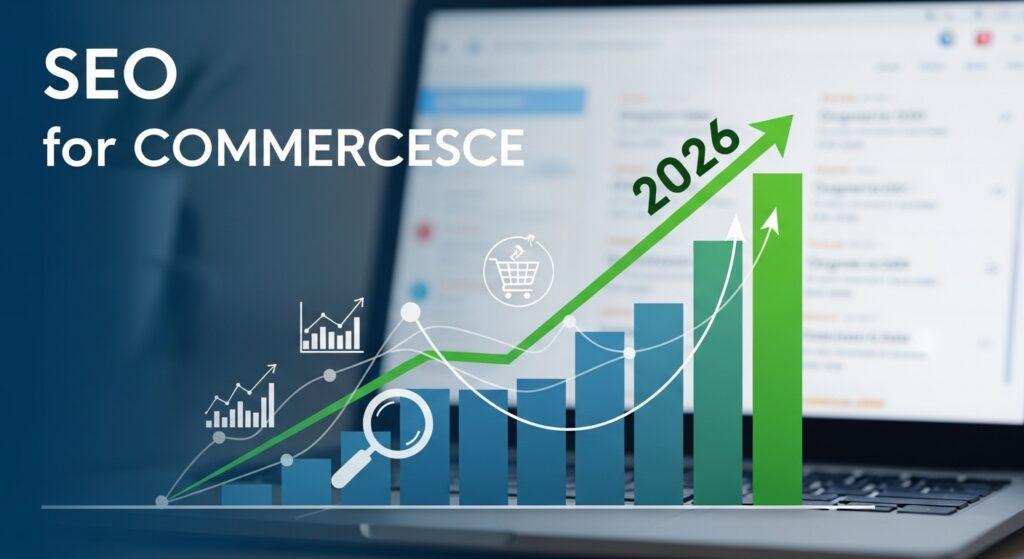
To answer “Why is SEO important for ecommerce in 2026” — it’s because SEO is the roadmap that guides shoppers to your store in an ever-more complex search landscape. No other channel offers the same blend of scale, cost-efficiency, and user intent alignment.
By investing in SEO now — optimizing your catalog, improving site performance, and building a trusted brand — online retailers set themselves up for lasting visibility and sales as the market continues to grow.
In short, SEO in 2026 is not optional; it’s indispensable for eCommerce success.
FAQs: SEO for Ecommerce in 2026
Why is SEO important for eCommerce websites?
SEO is crucial because it increases your store’s visibility to potential customers searching for products online. Better rankings mean more organic traffic, lower customer acquisition costs, and long-term brand trust.
How does SEO help increase eCommerce sales?
By ranking higher for relevant product keywords, SEO drives targeted visitors who are actively looking to buy. These visitors have a higher conversion rate compared to traffic from social media or paid ads.
Is SEO better than paid advertising for eCommerce?
Both channels are valuable, but SEO provides long-term, sustainable traffic without ongoing costs. Paid ads stop generating traffic once the budget ends, while SEO continues to bring organic sales for months or even years.
How long does SEO take to show results for an eCommerce store?
On average, SEO can take 3 to 6 months to show measurable results, depending on your website’s current authority, competition level, and the quality of your optimization efforts.
What are the most important ranking factors for eCommerce SEO in 2026?
The top factors include Core Web Vitals (page speed, stability), mobile usability, structured data, quality backlinks, and relevance to search intent. AI-driven search and user experience signals are also becoming more influential.
How does SEO improve customer experience on eCommerce sites?
Good SEO encourages faster load times, cleaner navigation, and more informative product content. These improvements make it easier for customers to find, understand, and purchase products.
Can small eCommerce businesses compete with large brands using SEO?
Yes. By targeting niche keywords, focusing on local SEO, and building authority through authentic content and customer reviews, small eCommerce brands can outperform larger competitors in specific areas.
What role do keywords play in eCommerce SEO?
Keywords connect your products with what customers are searching for. Using relevant, intent-driven keywords in product titles, descriptions, and metadata helps search engines understand your offerings.
How important is technical SEO for eCommerce?
Extremely important. Technical SEO ensures your website is crawlable, fast-loading, and mobile-friendly. Without a solid technical foundation, even great content can fail to rank.
How do product reviews affect SEO performance?
Authentic product reviews add user-generated content and trust signals to your pages. They also naturally include long-tail keywords, helping your products appear for more specific search queries.
What are the long-term benefits of SEO for eCommerce?
SEO builds lasting visibility, authority, and trust. Over time, your store receives consistent organic traffic, reduces dependency on paid ads, and achieves higher ROI through sustained growth.
What keyword tools are best for eCommerce SEO?
Top tools include Google Keyword Planner, Ahrefs, SEMrush, Moz, and Ubersuggest for keyword insights and competitor analysis.
Why is organic traffic so valuable for eCommerce businesses?
Because it brings in high-intent visitors for free, builds brand trust, and drives long-term, consistent sales without ongoing ad spend.
How do I handle duplicate content in product descriptions?
Write unique descriptions, use canonical tags for similar pages, and avoid copying manufacturer text to prevent ranking issues.
Does blogging help improve eCommerce SEO?
Yes. Blogging boosts organic traffic, builds authority, and supports product rankings by targeting informational keywords.